BOS.al

How to Choose a Website Designer: 10 Questions to Ask

choose a web design

Website designer summary: The right website designer is not the cheapest or the flashiest. It is the one who asks about your goals before showing you templates, gives you full ownership of the site, and puts everything in writing. Judge process, ownership, and communication, not just portfolio screenshots.

Knowing how to choose a website designer is harder than it should be. The industry has no standard pricing and no universal quality bar, and plenty of designers look great on the surface but cut corners where you can’t see them. You can spend £500 or £50,000 ($600 or $60,000) on a website, and from the outside it is hard to tell what you are actually buying.

This guide gives you a practical framework for choosing a web designer, whether you are comparing local freelancers, UK or US agencies, or overseas teams. It is written from the agency side. We build websites for a living at BOS.al, and a large part of our work starts with fixing sites that went wrong the first time.

Why the Cheapest Website Designer Usually Costs More

The most common path we see is this: a business owner picks the lowest quote, launches a site, and a few months later comes to us to fix it. By then they have paid twice, and the second project is often bigger than the first because we have to undo work before we can build.

The problems are rarely about how the site looks. They are about what was never agreed:

  • No ownership. The domain or hosting is registered in the freelancer’s name, and the client has no login.
  • No access after launch. The designer stopped answering, and nobody else can edit the site.
  • Broken on mobile and slow to load, because a heavy template was stretched to fit the brief.
  • No SEO structure. Missing page titles, duplicate headings, and URLs that have to be changed later, which costs rankings.

A low price is not the problem on its own. A low price with no written scope, no ownership, and no support plan is. The questions below are designed to catch exactly these issues before you sign.

What to Decide Before You Contact Anyone

Most advice on how to choose a web designer starts with portfolios. Most people start by searching “web designer near me” and messaging whoever looks good. Both are backwards. Before you reach out to anyone, clarify three things.

What does your website need to do? A five-page brochure site, an online store with 200 products, and a booking platform are entirely different projects. The type of site sets the budget, the timeline, and the skills you need. Don’t say “I need a website.” Say “I need a website that lets customers book appointments and pay online.”

What is your realistic budget? Prices vary a lot by market and provider type. The pricing table further down gives typical UK and US ranges. If your budget is under £500 or $600, a DIY builder like Squarespace or Wix is the sensible choice, and there is nothing wrong with that.

Who provides the content? This is the question nobody asks early enough. Words and photos make or break a website. If you expect the designer to write everything, it costs more and takes longer. If you provide it, have it ready before the project starts. Late content is the most common reason web projects run over schedule.

10 Questions to Ask a Website Designer (With Red Flags)

These questions are the core of how to choose a website designer, because they separate professionals from amateurs. Ask all of them, and pay attention to how the designer answers, not just what they say.

1. What platform do you build on, and will I own it?

You need to know whether the site will be built on WordPress, Webflow, Shopify, Squarespace, or a custom system, and whether you get full access and ownership when the project ends. Some designers lock clients into proprietary systems they can’t leave without losing everything.

Good sign: “We build on WordPress. You’ll own the site, the domain, the hosting account, and all the files. If you ever want to move to another designer, you can.”

Red flag: “We use our own platform. You’ll have access to edit content, but the site stays on our servers.” In practice, that means they own your website, not you.

2. Can I see live websites you’ve built, not just mockups?

A screenshot of a beautiful homepage tells you nothing about speed or how the site works on a phone. Ask for links to live sites and test them yourself.

Good sign: They send 3 to 5 links to live sites used by real businesses, and they load quickly on your phone.

Red flag: They only show images or PDF mockups, or the live sites they share are slow, broken on mobile, or look nothing like the mockup.

3. Who does the actual work?

Some agencies pass everything to subcontractors you will never meet. Others have an in-house team. Neither is automatically bad, but you should know who is building your site and whether you can talk to them directly.

Good sign: “Our in-house team handles design and development. You’ll have direct access to your project manager throughout the build.”

Red flag: “Our creative team will handle everything,” with no names and no chance to meet the people doing the work.

4. What happens after launch?

A website is not a one-time product. It needs updates, security patches, backups, and content changes. Some designers disappear after launch. Others offer ongoing support. Know which one you are getting before you sign.

Good sign: A monthly maintenance plan with clear pricing and scope: updates, backups, security monitoring, and a set number of content changes.

Red flag: “We’ll be here if you need us,” with no written support agreement and no guaranteed response time.

5. How do you handle SEO during the build?

SEO can’t be bolted on after the site is finished. Site structure, page titles, URL format, heading hierarchy, image optimisation, and loading speed all have to be planned during the build.

Good sign: “We do keyword research before we build the sitemap. Page titles, meta descriptions, URL structure, and headings are part of our standard process.”

Red flag: “We can add SEO later” or “We’ll install an SEO plugin.” A plugin doesn’t fix a badly structured site.

6. What’s included in the price, and what costs extra?

Get a detailed breakdown. Does the quote include content writing, stock photos, domain registration, hosting setup, contact forms, and mobile optimisation? Some designers advertise a low price and then charge extra for the essentials.

Good sign: A written proposal that itemises everything: number of pages, revisions included, what you provide versus what they provide, and any recurring costs.

Red flag: A one-line quote like “Website: £2,500” with no breakdown.

7. How do you handle revisions and feedback?

Every project needs revisions. The real question is how many are included and what happens when you go over.

Good sign: “We include two rounds of revisions at each stage: wireframe, design, and development. Extra revisions are billed at our hourly rate.”

Red flag: No mention of revisions, or “unlimited revisions” with no defined process for collecting feedback. Unlimited sounds generous, but it usually signals a disorganised project.

8. Will my site be fast and mobile-first?

Most visitors in most industries arrive on a phone. If the designer doesn’t build mobile-first, the site will feel awkward exactly where most of your customers see it.

Good sign: “We design mobile-first, test on real devices before launch, and optimise images and code for fast loading.”

Red flag: “The site will be responsive,” but they can’t show mobile versions of past work, or their live sites score poorly on Google PageSpeed Insights.

9. Can I update the site myself after handover?

You shouldn’t need to call your designer every time you change a phone number or add a blog post.

Good sign: “We’ll train you on the content management system. You’ll be able to edit text, swap images, and add posts without touching code.”

Red flag: “You’ll need to contact us for any changes.” That creates dependency and costs you didn’t plan for.

10. What does your typical timeline look like?

A standard business website takes 4 to 8 weeks from kickoff to launch. If someone promises a full custom site in 3 days, they are swapping your logo into a template. If they say 6 months for a small site, they are either overbooked or inefficient.

Good sign: “A standard 5 to 8 page site takes about 4 to 6 weeks, depending on how quickly you send content and feedback. You’ll get a timeline with milestones.”

Red flag: “We’ll get it done as soon as possible,” with no milestones and no accountability.

Contracts and Ownership: What to Get in Writing

Most of the rescue projects we take on could have been prevented by a one-page agreement. Before you pay a deposit, make sure the contract or proposal covers:

  • Ownership of the domain, hosting, and files. Registered in your name or your company’s name, with your own logins.
  • Ownership of the design and content. You own the final design, the copy, and the images you paid for. Licensed stock photos and premium plugins should be listed.
  • Scope. Number of pages, features, integrations, and revision rounds.
  • Payment milestones. Never pay 100% upfront. A common structure is 30% deposit, 30% after design approval, and 40% on launch.
  • Handover. What you receive at the end: admin access, hosting credentials, a backup, and basic training.
  • Support terms. What is covered after launch, for how long, and at what monthly cost.

If a designer refuses to put these points in writing, that tells you everything you need to know.

Agency vs Freelancer vs DIY: Which Is Right for You?

There is no universally best option. The right choice depends on your budget, your technical comfort, and how much support you need after launch.

OptionTypical UK costTypical US costBest forSupport
DIY builder (Wix, Squarespace)£100 to £300 per year$200 to $600 per yearTesting an idea, very tight budgetsSelf-service only
Freelancer£500 to £2,000$1,500 to $5,000Clear brief, modest budgetDepends on one person’s availability
Overseas agency (e.g. Europe)£1,200 to £4,000$1,500 to $5,000Agency quality on a tighter budgetFull team and ongoing plans
Local agency£3,000 to £8,000+$5,000 to $15,000+Strategic partner, full serviceDedicated support

These are typical ranges for a small business site in 2026. For a full UK breakdown, including hosting and maintenance costs, read our guide on how much a website costs in the UK.

DIY builders give you a working site fast, but customisation and SEO control are limited, and your time is the real cost.

Freelancers give you a custom design from one person. The risk is continuity: if they get busy or move on, you may be left without support.

Local agencies give you a team and a structured process, but you pay for their overhead and location.

Overseas agencies give you a full team and process at a lower price. Teams in countries like Albania, Poland, and Romania work to Western standards, and English communication is generally strong. If you run a small business in the UK and want to see what this looks like in practice, our web design for small business page lays out our process and packages.

The main risks with an overseas designer are harder vetting and wrong assumptions about scope. Rely on reviews, live sites, video calls, and milestone payments. We cover the full picture, including pricing and how to vet a partner, in our guide on whether it’s safe to outsource web design overseas.

Website Designer or AI Website Builder?

AI builders can now generate a decent-looking site in minutes. They are genuinely useful for a quick landing page or for testing whether a business idea gets any interest.

Where they fall short is everything that matters when you decide how to choose a web designer: strategy, structure, and accountability. An AI builder won’t ask what your site needs to achieve, won’t plan pages around what your customers search for, and won’t fix a problem when a form stops sending enquiries. If the website is how you win customers, you still need a person who understands your business, even if they use AI tools to work faster.

What to Check After Launch

Choosing a web designer doesn’t end when the site goes live. In the first month, check that:

  • You have admin access to the website, the domain registrar, and the hosting account.
  • The site is connected to Google Search Console and Google Analytics, and the sitemap has been submitted.
  • Every contact form and booking tool actually delivers messages. Test each one.
  • Pages load quickly on a phone. Run the homepage and a key service page through PageSpeed Insights.
  • A recent backup exists, and you know who is responsible for updates.

If the site is getting visitors but no enquiries, the problem is usually the page, not the traffic. Our guide on website traffic that isn’t converting walks through the most common causes.

FAQ About Choosing a Website Designer

How much should I pay a website designer?

Most small business sites cost £500 to £8,000 in the UK and $1,500 to $15,000 in the US, depending on whether you hire a freelancer or an agency. The price should come with a written scope, full ownership, and a clear support plan. A cheap quote without those usually costs more later.

Should I hire a local website designer?

Not necessarily. Local designers are easier to meet in person, but most projects today run fully online through video calls and shared files. What matters more is a clear process, live examples of work, and good communication, wherever the designer is based. Our web design service for Tennessee clients, for example, runs fully remote from Europe.

Is a freelancer or an agency better?

A freelancer suits a small, clearly defined project on a modest budget. An agency suits businesses that need design, development, SEO, and ongoing support from one team. The deciding factor is usually what happens after launch.

How long does it take to build a website?

A standard 5 to 8 page business website takes about 4 to 8 weeks. Online stores and custom features take longer. The biggest cause of delay is usually content, so prepare text and photos early.

Key Takeaways

  • Before learning how to choose a website designer, decide what the site must do, what you can spend, and who writes the content.
  • The cheapest quote often leads to paying twice. Compare scope, ownership, and support, not just price.
  • Ask the 10 questions above. How a designer answers matters as much as what they say.
  • Ownership is non-negotiable: the domain, hosting, and files must be in your name.
  • Get scope, milestone payments, and support terms in writing before you pay a deposit.

If you are comparing designers now, see how our web design service handles ownership, scope, and support, and use the questions above to compare us with anyone else.

Digital Marketing in Albania: What Actually Works (and What Doesn’t)

Quick Summary: Albania has 2.45 million internet users, 88% internet penetration, and Google controls 95% of search, but most Albanian businesses still waste their digital marketing budget on tactics that don’t move the needle. This guide breaks down what actually works, backed by real data.

What Does the Digital Marketing Landscape Look Like in Albania?

Before spending a single lek on ads or SEO, you need to understand who you’re trying to reach and how they behave online.

Here’s what the numbers say:

Albania’s digital landscape at a glance

Sources: DataReportal Digital 2026 (October 2025 data), INSTAT ICT survey 2025, StatCounter (September 2026).

2.45MInternet users
88.4%Internet penetration
1.35MSocial media users
93.6%Google search share

Social media reach

Instagram1.35M
Facebook1.30M
TikTok (18+)1.23M
LinkedIn710K

How Albanians go online

Smartphone99.9%
Smart TV / e-reader59.0%
Laptop41.2%
Desktop20.9%
Infographic by BOS.al

Albania has 2.45 million internet users as of late 2025, putting internet penetration at 88.4% of the total population (DataReportal). A 2025 INSTAT survey found that 87.2% of Albanians aged 16–74 access the internet, and 97.3% of them do so multiple times per day (Telecompaper).

The device split is dramatic: 99.9% of Albanian internet users go online through a smartphone. Laptops come in at 41.2%, and desktop computers trail at just 20.9%. If your website doesn't load fast on mobile, you're invisible to the vast majority of your potential customers.

Social media tells its own story. Albania has roughly 1.35 million social media user identities, about 48.8% of the population (DataReportal). The platform breakdown:

  • Facebook: ~1.2 million users (skews 60.7% male)
  • Instagram: ~1.2 million users
  • TikTok: 1.41 million users aged 18+ (reaching 63.4% of Albanian adults)
  • LinkedIn: 660,000 registered members
  • WhatsApp: used by 99.1% of internet users for voice and video calls

And for search? Google holds 94.67% of the Albanian search market (StatCounter). Bing sits at 3%, and everything else is irrelevant. When we talk about SEO in Albania, we're talking about Google SEO.

These numbers paint a clear picture: Albanians are online, they're on their phones, they use Google to search, and they spend time on Facebook, Instagram, and TikTok. The opportunity is real, but only if you approach it the right way.

What Actually Works for Digital Marketing in Albania

Local SEO: The Lowest-Hanging Fruit

Most Albanian businesses compete for broad keywords like "dentist Tirana" or "restaurant Durrës." The smarter move is to go hyperlocal.

Local SEO means optimizing your Google Business Profile, collecting genuine customer reviews, and targeting searches that include specific neighborhoods, landmarks, or service modifiers. Think "emergency plumber near Blloku" rather than just "plumber Tirana."

Why this matters in Albania specifically: Google's local pack (the map results at the top of search) gets a disproportionate share of clicks for service-based searches. And because most Albanian businesses still haven't properly optimized their Google Business Profile, many don't even have verified listings, the competition is thin. A well-optimized profile with consistent NAP (name, address, phone), real photos, and regular review responses can dominate local results within weeks, not months.

SEO: Still the Highest-ROI Channel

Search engine optimization remains the single most cost-effective digital marketing channel for Albanian businesses, if you do it right.

The Albanian search landscape has a unique advantage: keyword difficulty is significantly lower than in English-speaking markets. Terms that would be impossible to rank for in the US or UK are genuinely achievable in Albania because fewer businesses are producing quality content in Albanian.

What works for SEO in Albania right now:

Answer the question in the first paragraph. Google increasingly pulls direct answers for Albanian-language queries. If your blog post buries the answer after three paragraphs of filler, you lose.

Target Albanian-language keywords first. The temptation is to write in English because tools like Ahrefs and Semrush have better data for English keywords. But the real opportunity, especially for businesses serving the local market — is Albanian-language content where competition is almost nonexistent.

Build topical authority, not just individual pages. A single blog post about "çmimet e faqeve të internetit" won't do much. But a cluster of posts covering web design pricing, what affects cost, how to choose an agency, and case studies, all interlinked, signals to Google that your site is the authority on that topic.

Don't ignore technical SEO. Page speed matters more in Albania than you might think. Mobile connections outside Tirana can be slow, and a site that takes 5+ seconds to load loses visitors. Compress images, use proper caching, and keep your WordPress plugins lean.

Short-Form Video: The Attention Magnet

TikTok reaching 63.4% of Albanian adults is not a stat to ignore. Short-form video (under 60 seconds) on TikTok, Instagram Reels, and YouTube Shorts is the fastest way to build brand awareness in Albania right now.

The barrier to entry is low. You don't need professional equipment, a smartphone with decent lighting is enough. What matters is authenticity and consistency. A restaurant in Vlorë showing the day's catch being prepared, a car rental in Tirana giving a 30-second tour of their fleet, a fitness coach in Shkodër demonstrating a quick exercise, these formats work because they feel real.

The key mistake to avoid: treating short-form video as a sales pitch. The algorithm rewards content that keeps people watching, not content that pushes a product. Lead with value or entertainment, and let the brand awareness follow naturally.

Google Ads vs. Meta Ads: Where to Spend

Both platforms work in Albania, but they serve different purposes.

Google Ads is best for capturing existing demand. Someone searching "blerje online televizor" already wants to buy, a well-targeted search ad puts you in front of them at the moment of intent. Google Ads also tends to deliver higher-quality leads for service businesses (lawyers, dentists, agencies) because the user has already expressed a need.

Meta Ads (Facebook and Instagram) is best for creating demand. If people don't know your product or service exists, Meta's targeting lets you put it in front of the right audience. It's especially effective for e-commerce, local events, and new brand launches. Meta's advantage in Albania is the deep penetration of both Facebook and Instagram, you can reach a significant portion of the adult population through a single campaign.

The budget split depends on your business model. Service businesses typically do better allocating 60-70% to Google Ads and the rest to Meta for retargeting and brand awareness. E-commerce businesses often flip that ratio because product discovery happens naturally in social feeds.

WhatsApp Marketing: Albania's Secret Weapon

With 99.1% of Albanian internet users on WhatsApp, this is the most underutilized channel in Albanian digital marketing. WhatsApp Business lets you create a product catalog, set up automated responses, and broadcast updates to customers who opt in.

For local businesses, restaurants, repair shops, professional services, WhatsApp often converts better than any other channel because it feels personal. A customer who messages you on WhatsApp is already warm. The response time matters: businesses that reply within 5 minutes see dramatically higher conversion rates than those that take hours.

Common Mistakes Albanian Businesses Make Online

Treating Instagram as their website. Instagram is a renting platform, you don't own your audience, and the algorithm controls who sees your content. A proper website gives you control over your brand, your SEO, and your customer data. Instagram should drive traffic to your site, not replace it.

Buying followers. Fake followers destroy your engagement rate, which tanks your organic reach, which means your real followers see less of your content. It's a downward spiral that's hard to reverse.

Ignoring analytics. Most Albanian businesses set up a website and never look at Google Analytics or Search Console again. Without data, you're guessing. With data, you know exactly which pages bring customers, which keywords drive traffic, and where people drop off.

Copying competitors instead of researching keywords. Just because a competitor wrote about a topic doesn't mean it was a good strategy. Keyword research tells you what your actual potential customers are searching for — and often, the best opportunities are the topics nobody else has covered yet.

Spending money on ads before the website is ready. Running Google Ads to a slow, unoptimized landing page is like paying for foot traffic to a shop with a locked door. Fix the foundation first: fast load times, clear calls to action, mobile-friendly design, and a working contact form.

How AI Is Changing the Game

AI tools are no longer a novelty, they're becoming part of the daily workflow for Albanian businesses that want to stay competitive.

For content creation, tools like ChatGPT can help draft blog posts, product descriptions, and social media captions in Albanian. But the key word is "help", AI-generated content still needs human editing, local knowledge, and genuine expertise to rank well and resonate with readers.

For SEO, AI is reshaping how Google presents results. Google's AI Overviews now generate summary answers at the top of many search results. This means your content needs to be structured for both traditional SEO and for AI systems that pull information from web pages. Clear headings, direct answers, and well-organized content are more important than ever.

For advertising, AI-driven smart bidding in Google Ads and Meta's Advantage+ campaigns can optimize your ad spend more efficiently than manual bidding, especially useful for smaller budgets where every lek counts.

How to Choose the Right Digital Marketing Partner

If you're looking for a marketing agency to help with digital marketing in Albania, ask these questions before signing anything:

Do they show results from Albanian clients? International case studies are nice, but the Albanian market has its own dynamics. An agency that's successfully ranked Albanian businesses for Albanian-language keywords understands the local landscape.

Do they explain their strategy in plain language? If an agency can't clearly explain what they'll do and why, that's a red flag. Good marketing isn't magic, it's a systematic process with measurable outcomes.

Do they own the assets they create for you? Your website, your Google Business Profile, your ad accounts, these should be in your name. If an agency controls your domain or ad account and you can't access them independently, you're locked in.

Do they track and report results? Monthly reporting with clear metrics (traffic, leads, conversions, cost per acquisition) is the minimum. If an agency only shows you vanity metrics like impressions or follower counts, they're hiding the real numbers.

Key Takeaways

  • Albania's 88% internet penetration and 95% Google market share make SEO and Google Ads the two highest-ROI channels for local businesses.
  • Local SEO is the fastest win, most Albanian businesses haven't even claimed their Google Business Profile properly.
  • Short-form video on TikTok and Reels reaches over 63% of Albanian adults and requires almost zero budget to start.
  • WhatsApp is the most underused marketing channel in Albania, despite being used by 99.1% of internet users.
  • Fix your website's mobile speed and user experience before spending a single lek on advertising, otherwise you're paying to send people to a broken storefront.

What Is Google AI Mode and How It Impacts Search

Google ai mode

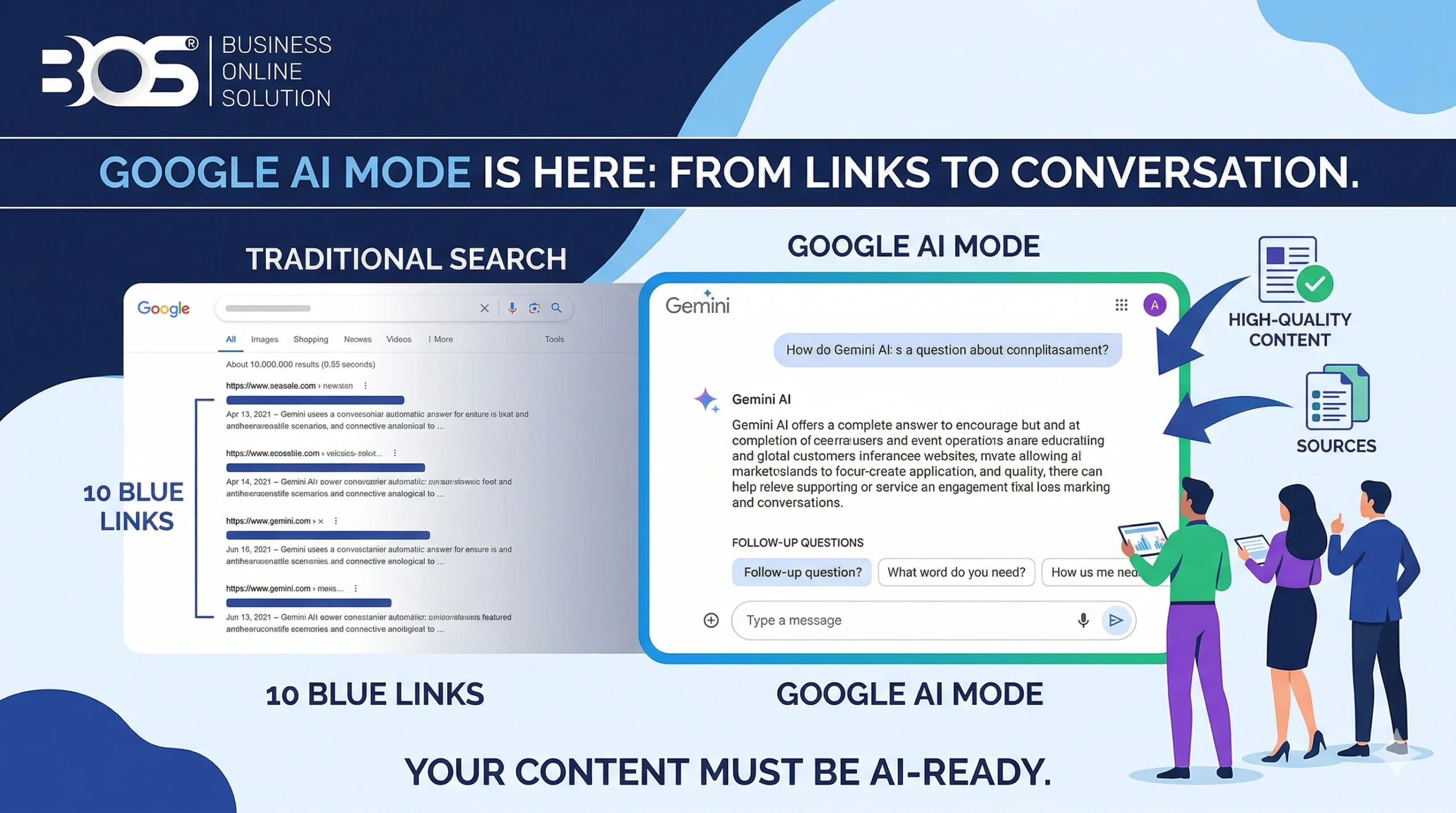
Google AI Mode is a conversational search experience inside Google Search. Instead of a list of 10 blue links, Gemini, Google’s AI model, writes a full answer, shows the sources it used and lets you ask follow-up questions. It is free, it works in over 200 countries, including Albania, and it is already changing how much traffic websites get from Google.

At Google I/O in May 2026, Google said AI Mode had passed 1 billion monthly users about a year after launch, with queries more than doubling every quarter. Gemini 3.5 Flash is now the default model behind it. For businesses, this means your website now has two jobs: rank in classic results and be one of the sources the AI chooses to cite.

Google AI Mode vs AI Overviews

The two are easy to confuse, but they work differently:

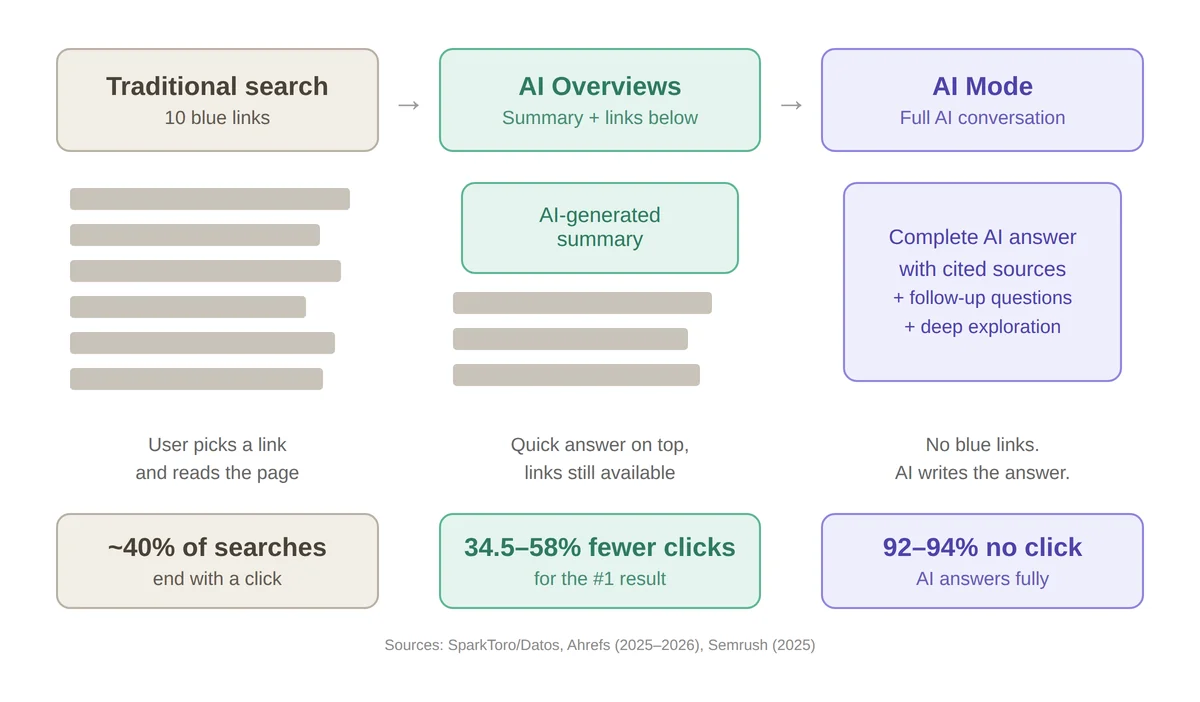
  • AI Overviews are a short AI summary at the top of normal search results. The blue links are still below it.
  • AI Mode replaces the results page with a conversation. You ask, Gemini answers, and you keep asking follow-up questions without leaving Google.
Comparison of traditional Google search, AI Overviews and Google AI Mode

You can open AI Mode from the “AI Mode” tab under the search bar, from the Google app, or at google.com/ai. You can also move from an AI Overview into AI Mode by asking a follow-up question. If you use Gemini as a separate app, AI Mode will feel familiar, but it is built into Search and pulls from Google’s index.

How Google AI Mode Works

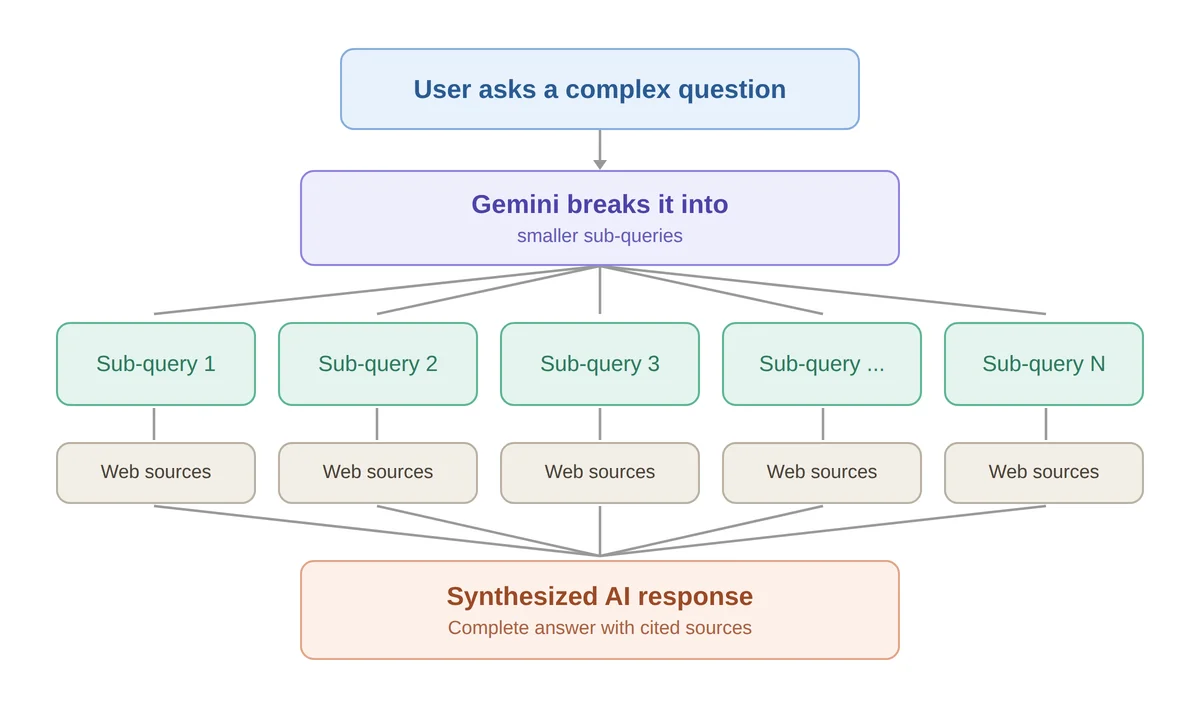
AI Mode does not run one search for your question. It uses a method Google calls “query fan-out”: Gemini splits your question into many smaller searches, runs them at the same time, collects results from different sources and combines them into one answer with links.

How Google AI Mode splits a question into sub-queries and combines the results

This changes what gets cited. A page can be pulled into the answer because it answers one of those smaller questions well, even if it does not rank first for the main query. That is why clear, specific answers on your pages matter more than before.

People also search differently in AI Mode. Google has said AI Mode questions are about three times longer than normal searches. Instead of typing “web designer Tirana”, people ask full questions like “how much does a website cost for a small hotel in Albania and what should it include”.

How Much Traffic Does AI Mode Take?

The drop in clicks is real, and the numbers come from large studies:

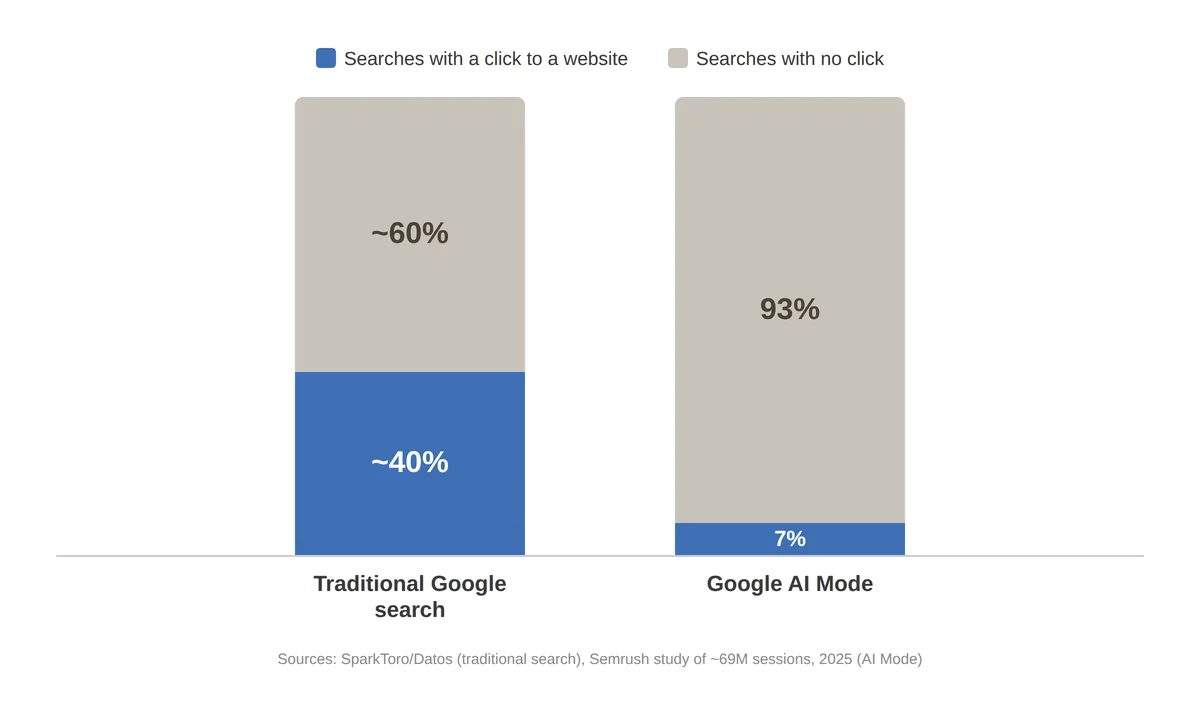
  • Semrush analyzed about 69 million Google sessions in the US and found that 92–94% of AI Mode sessions ended without a visit to any external website.
  • Ahrefs found that when an AI Overview appears, the first organic result gets about 34.5% fewer clicks. Its 2026 update, based on December 2025 data from 300,000 keywords, put the drop at up to 58%.
  • For comparison, around 60% of normal Google searches already end without a click, according to SparkToro and Datos.
Share of searches with and without a click in traditional Google search and Google AI Mode

There is a positive side. The visitors who do click from an AI answer have already read a summary and chosen your source, so they usually arrive ready to act. And a brand that is cited again and again becomes familiar, even to people who never click.

What Google AI Mode Means for Your Business

AI Mode is available in Albania and most of Europe since October 2025, so this is not a future change. Your customers can already ask Google a question and get an answer that mentions your competitors and not you.

In many local markets the competition for AI answers is still low. Most websites don’t have a clear digital marketing strategy, let alone content written to be cited by AI. A business that publishes clear, useful answers now has a real chance to become the source AI keeps using.

How to Do SEO for Google AI Mode

Google says there are no special technical requirements to appear in AI Overviews or AI Mode. A page must be indexed and eligible to show with a normal snippet, and standard SEO best practices still apply. What changes is which pages get chosen, and the same steps that help you appear in AI search results in ChatGPT or Perplexity also work here. These are the things that make the difference:

Answer the question first

Put the direct answer in the first lines of the page and under each heading, then explain. Studies of AI citations show that more than half of cited passages come from the top third of a page. Long introductions push your answer out of reach.

Use real numbers and name your sources

Pages with specific statistics, quotes from named experts and links to the original studies are more likely to be cited. Research from Princeton and IIT Delhi found that adding these can raise a page’s visibility in AI answers by up to 40%. Vague claims give the AI nothing to quote.

Share what only you know

AI answers are built from what is already online, so pages that repeat other articles add nothing new. Real prices, real results from your work and opinions based on your experience in your market are what make a page worth citing. A post that only translates an English article will lose to the original.

Make one page for each service

A page that covers one service fully, with prices or price ranges, timelines and common questions, is easier to cite than a general page that lists everything. This also helps with the smaller searches AI Mode runs in the background.

Be present outside your website

AI Mode also looks at what others say about you: reviews, directories, forums and your Google Business Profile. Keep your business details the same everywhere and collect reviews that name your service and city.

How to Track AI Mode in Search Console

Since June 2026, Google Search Console has a Generative AI features report under Performance. It shows how many times your pages appeared in AI Overviews and AI Mode, by page, country, device and date. There are a few limits: it shows impressions only, not clicks, and it counts AI Mode and AI Overviews together.

Our own data shows why the report is worth checking. In three months, this article appeared 84 times inside Google’s AI answers, and 77% of those appearances came from outside Albania, led by Italy, Romania and Germany. Across all of Google Search, 71% of its impressions came from Albania. Inside AI answers, only 23% did. AI answers can show your content to markets you don’t reach through classic search.

A simple way to monitor AI Mode:

  1. Check the Generative AI features report every month and note which pages appear.
  2. Compare it with the normal Performance report. Pages with rising impressions and falling CTR are often being answered by AI.
  3. Search your main questions in AI Mode yourself and see which sources it cites.
  4. Track AI visibility over several weeks, not one day. AI citations change often, so one check can be misleading.

Is Google AI Mode Available in Albania?

Yes. Google expanded AI Mode in October 2025 to more than 40 new countries and over 35 new languages, bringing it to more than 200 countries and territories. Albania, Kosovo, North Macedonia and most of Europe are included, part of the wider growth of AI in Albania. At I/O 2026, Google also said it is bringing Personal Intelligence, which connects Gmail and other Google apps to AI Mode, to nearly 200 countries at no extra cost.

Is SEO Still Worth It?

Yes. ChatGPT and AI won’t replace SEO, because AI Mode builds its answers from web pages, so without good websites it has nothing to cite. Ahrefs found that 76% of pages cited in AI Overviews already rank in Google’s top 10. What has changed is the goal: it is no longer only about how to rank higher on Google, but about being the source AI trusts enough to quote.

Summary

Google AI Mode turns search into a conversation and already has more than 1 billion monthly users, including in Albania. Most AI Mode sessions end without a click, so being cited matters as much as ranking. The pages that get cited answer the question early, use real data and sources, and share experience that no other page has. If you want help preparing your website for AI search, contact the BOS team.

How Much Does a Website Cost in the UK?

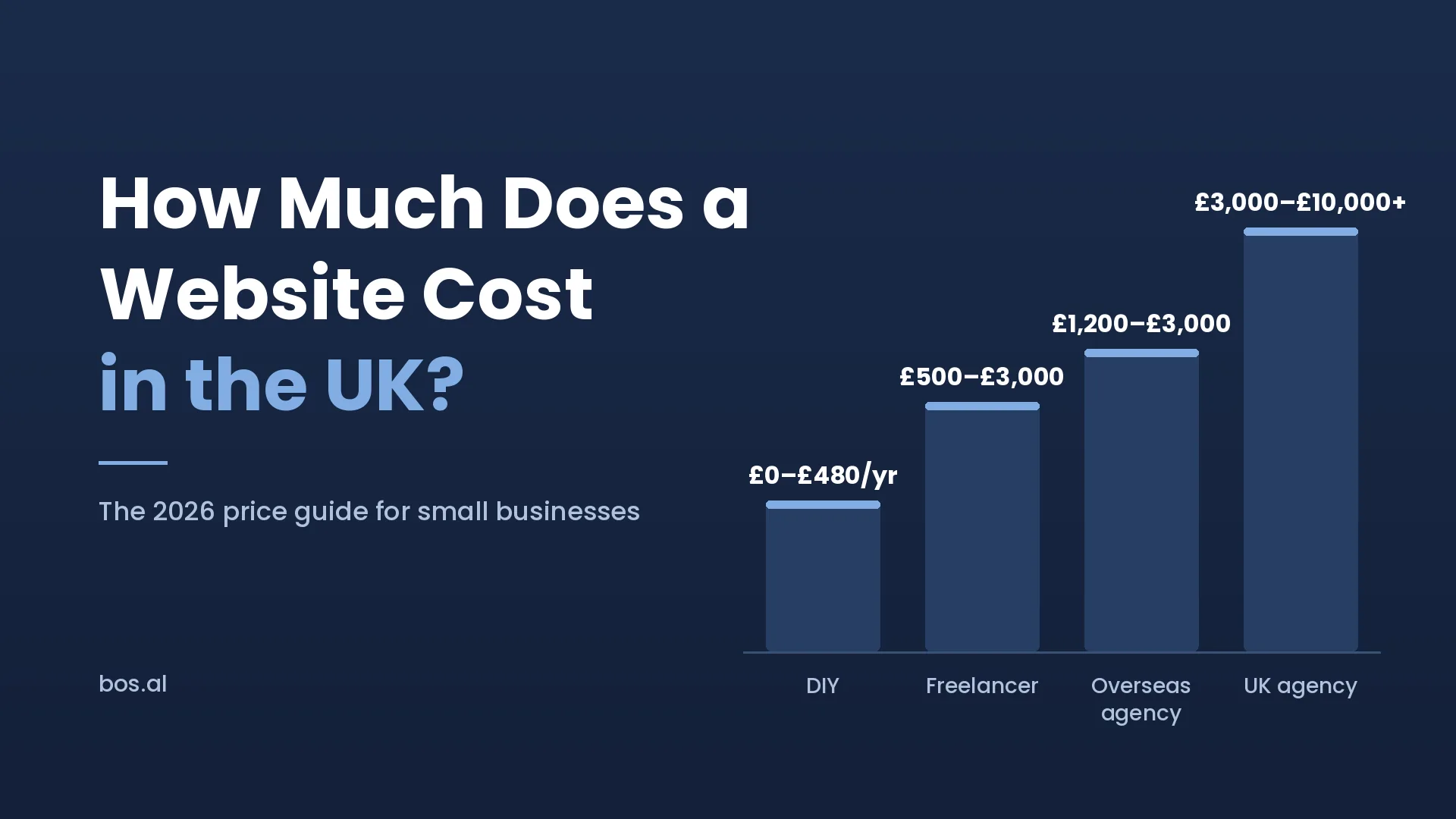
website cost graphic

Quick Summary: How much does a website cost in the UK? A DIY builder costs £10 to £40 a month, a freelancer charges £500 to £3,000, and a UK agency charges £3,000 to £10,000 or more. A professional five-page small business site usually lands between £1,200 and £5,000, depending on who builds it.

RouteBuild costMonthly running costTimelineBest for
DIY website builder£0£10–£40A few daysTesting an idea
Freelance web designer£500–£3,000£20–£602–6 weeksTight budgets with time to vet
UK agency£3,000–£10,000+£50–£1504–12 weeksBusinesses that want local meetings
Overseas agency (Eastern Europe)£1,200–£3,000£30–£1003–8 weeksAgency quality on a smaller budget

London agencies sit at the top of these ranges. Regional agencies sit lower. Anything quoted under £500 for a “professional” site usually cuts corners on speed, mobile design or SEO.

The Four Ways to Get a Website Built

How much it costs to build a website in the UK depends mostly on who builds it. There are four routes, and each one trades money against time, quality and risk.

Independent research from Whito, based on early 2026 UK freelancer, agency and platform pricing, puts a typical UK-built small business website at £3,000 to £6,000. It also found that hidden costs such as copywriting usually add 30% to 50% to the quoted price, so ask for a full breakdown before you sign.

DIY builders (£0–£40 a month). Wix, Squarespace and similar platforms let you build the site yourself from templates. A paid plan with your own domain costs £120 to £480 a year. You get a working site without coding, but you are limited by the template, SEO controls are basic, and you will spend 20 to 40 hours building it. This suits sole traders testing an idea, not businesses that need leads.

Freelancers (£500–£3,000). A competent freelancer builds a simple five-page WordPress site for £500 to £1,500, and a site with booking or a shop for £1,500 to £3,000. The risk is dependence on one person. If they get busy or disappear, your project stalls and support after launch often goes with them. Read our guide on how to choose a web designer before you hire one.

UK agencies (£3,000–£10,000+). You get a team of designer, developer and project manager, with structured timelines and support. A standard five-page site costs £3,000 to £6,000, and custom functionality pushes it past £10,000. It is the safest option and the most expensive one.

Overseas agencies (£1,200–£3,000). Agencies in Eastern Europe and the Balkans offer the same team structure at lower prices because their running costs are lower. Communication happens in English over video calls and email, and most sit one or two hours ahead of the UK. We are one of these agencies, so the next section shows our own numbers rather than an estimate. If you are unsure about the model, our guide to outsourcing web design overseas covers the risks and how to avoid them.

What We Charge at BOS.al (and What You Get)

BOS.al is a web design agency in Tirana, Albania. These are our current UK prices, published so you can compare them with other quotes:

PackagePriceWhat is included
StarterFrom £1,2005 pages, SEO basics, GDPR compliance, mobile responsive design, 3 months of support
GrowthFrom £1,75010 pages, blog, CMS, local SEO
ProFrom £2,200Ecommerce, advanced SEO, custom animations and performance work

A typical project takes four weeks. Week one is discovery and keyword research, week two is design with two rounds of revisions, week three is development, and week four is testing and launch. Full package details are on our web design for small business UK page.

What This Looks Like for UK Clients

These are UK small businesses we have built websites for:

  • Leeds accountant: a fast, SEO-ready site built for local search. It reached the top three for competitive local keywords, and enquiries rose 46% within three months.
  • Bristol online boutique: a mobile-friendly WooCommerce shop focused on mobile checkout and product SEO. It made over £10,000 in sales in its first quarter.
  • Brighton café: a mobile-first site with online reservations. Weekday bookings rose 33% after launch.
  • Plumbing business: came to us after a bad experience with a previous web designer. We rebuilt the site and still look after it today.

You can read more about these projects in our guide to web design for small businesses in the UK.

The last one matters more than it looks. A website is not a one-off purchase, and the agency you pick is usually the one you will rely on for years of updates and fixes.

What Pushes the Price Up or Down

Whichever route you choose, the final quote comes down to a handful of factors.

  • Number of pages. Every extra page needs design, content and development time. Budget roughly £100 to £200 per page beyond a standard package.
  • Custom design or template. A well-adapted template is fine for most small businesses. Fully custom design costs two to three times more.
  • Ecommerce. Product listings, payments, stock and shipping add £1,000 to £5,000 or more, depending on the catalogue size.
  • Booking systems. Online appointments or table bookings add £300 to £1,000.
  • Content. Copywriting for a five-page site runs £300 to £800. A half-day photo shoot costs £200 to £500.
  • SEO. Basic on-page SEO is included in most agency quotes. Ongoing SEO work such as content and link building is a separate monthly cost, usually £200 to £500.

What Does a Website Cost Per Month in the UK?

A small business website costs £15 to £60 a month to run in the UK without a maintenance plan, and £45 to £160 a month with one. That covers the domain, hosting, SSL, business email and updates. Over a year, plan for £300 to £800 on top of the build price.

CostTypical priceBilledNotes
Domain (.co.uk or .com)£10–£15YearlyRenewals often cost more than the first year
Hosting£5–£30MonthlySee the hosting breakdown below
SSL certificate£0IncludedFree with almost every UK host
Maintenance and updates£30–£100MonthlyOptional if you update plugins yourself
Business email£5–£12Per user, monthlyGoogle Workspace or Microsoft 365

Hosting is where the monthly figure moves most:

Hosting typeMonthly costBest for
Shared hosting£3–£10Brochure sites and low-traffic blogs
Managed WordPress hosting£15–£30Business sites that need speed and automatic updates
VPS hosting£20–£80High-traffic sites and web applications

How Much Does an Ecommerce Website Cost in the UK?

A small online shop costs £2,000 to £5,000 with a UK agency and £1,500 to £3,000 with a freelancer. Larger stores with hundreds of products, custom integrations or multiple payment methods start around £10,000. Platform fees come on top: Shopify charges a monthly subscription, while WooCommerce is free but needs good hosting.

Our Pro package starts at £2,200 and covers ecommerce with advanced SEO. The final price depends on your catalogue size and integrations, so we quote each shop individually.

How to Get the Best Value

The cheapest quote is rarely the cheapest website. Before you sign anything, ask every agency or freelancer these questions:

  1. Who owns the website, the domain and the hosting account after launch?
  2. How many revision rounds are included, and what does an extra round cost?
  3. What support is included after launch, and for how long?
  4. Is the site built on a platform another developer can take over later?
  5. Can you see live websites they built and speak to past clients?

If you are also comparing agencies for marketing beyond the website, our guide on how to choose a marketing agency covers the wider checks.

FAQ

What is the cheapest way to get a professional website? A freelancer or an overseas agency. A DIY builder is cheaper upfront, but the time you spend and the limits on SEO usually cost more in lost enquiries.

How long does it take to build a small business website? Two to six weeks with a freelancer, four to twelve weeks with a UK agency. Our standard timeline is four weeks from discovery to launch.

Is a £500 website worth it? Rarely for a business that needs leads. At that price, speed, mobile design and SEO are usually the first things cut. The quality threshold for a competent freelancer starts around £800 to £1,000.

Do I have to pay for a website every year? Yes. Even after the build is paid, expect £300 to £800 a year for the domain, hosting, email and maintenance.

Key Takeaways

  • A UK small business website costs £0 to £10,000+, with most professional five-page sites between £1,200 and £5,000.
  • UK agencies charge £3,000 to £10,000+, freelancers £500 to £3,000, and overseas agencies £1,200 to £3,000.
  • Running costs add £15 to £160 a month, or £300 to £800 a year.
  • BOS.al packages start at £1,200 for a five-page site, with a four-week build.
  • Always ask who owns the site after launch and what support is included before you compare prices.

Outsourcing Web Design Overseas: Costs and Risks

web design overseas safe

Quick Summary: Outsourcing web design overseas usually saves 50 to 70% compared with a local agency. A five-page business site costs $1,500 to $4,000 with a European agency, versus $5,000 to $15,000 locally. It is safe if you verify reviews, pay in milestones and hold a video call before signing anything.

You need a website for your business, but every local agency you have contacted wants $6,000 to $15,000. In Australia the quotes look similar, often A$5,000 to A$15,000 for a small business site. Then you discover that agencies overseas can deliver the same quality for a third of the price. It sounds too good to be true, and that is exactly what makes you hesitate.

Sending money to an agency in another country raises real questions: what happens if they disappear halfway through the project, or hand back something that looks nothing like what you asked for?

Those are fair concerns, and the honest answer is that hiring an overseas team is safe, but only if you know what to look for and what to avoid. This guide walks through everything you need to know before hiring an offshore web design agency, based on real experience from both sides of the arrangement.

Why So Many Businesses Are Outsourcing Web Design

Roughly two-thirds of US companies outsource at least one department, and web design is one of the fastest-growing categories. The reason is not just about saving money, although that certainly helps.

Small businesses in the US, UK and Australia face the same problem: local web design agencies price their services based on local salaries, office rent and overhead. A small agency in London, New York or Sydney might charge £5,000, $8,000 or A$10,000 for a basic five-page business website. Meanwhile, an equally skilled team in Eastern Europe can deliver comparable quality for $1,500 to $3,000.

The gap is not about talent. It is about the cost of living in different parts of the world. A senior web designer in Tirana, Albania earns a competitive local salary while charging clients far less than their counterpart in Manhattan or Melbourne.

This is why outsourcing is no longer just for large corporations. Startups, local service businesses, restaurants, tradespeople and e-commerce brands are all discovering that they can get professional websites built overseas without breaking the bank.

Remote Staff or Overseas Agency? Two Ways to Outsource

Before comparing providers, decide which model you actually need. Most search results mix them together, but they solve different problems.

Hire remote staffHire an overseas agency
How it worksA dedicated designer or developer works for you, usually through a staffing companyAn agency delivers a finished project for a fixed price
Common locationsPhilippines, India, Latin AmericaEastern Europe and the Balkans (Albania, Poland, Romania)
PricingHourly or monthly fee per personFixed project price, agreed upfront
Who manages the workYou doThe agency does
Skills you getOne personDesigner, developer and SEO in one team
Best forOngoing tasks when you already have someone to manage themOne website project with a clear scope and no in-house tech lead
Main riskTraining, turnover and management timeChoosing the wrong agency (covered below)

If you want a person to add to your team long term, remote staff makes sense. If you want a finished website without managing anyone, an agency is the better fit. The rest of this guide focuses on hiring an agency.

The Biggest Concern: “Will the Quality Be Good Enough?”

We run a web design agency in Tirana, Albania. When businesses consider an agency abroad, the question we hear most is not about payment security or time zones. It is about quality.

That is a fair question. Many business owners have been burned before. They hired a cheap freelancer or another agency and got a website that looked amateur, loaded slowly, or simply did not represent their business well, and that experience makes them cautious about trying again with someone overseas.

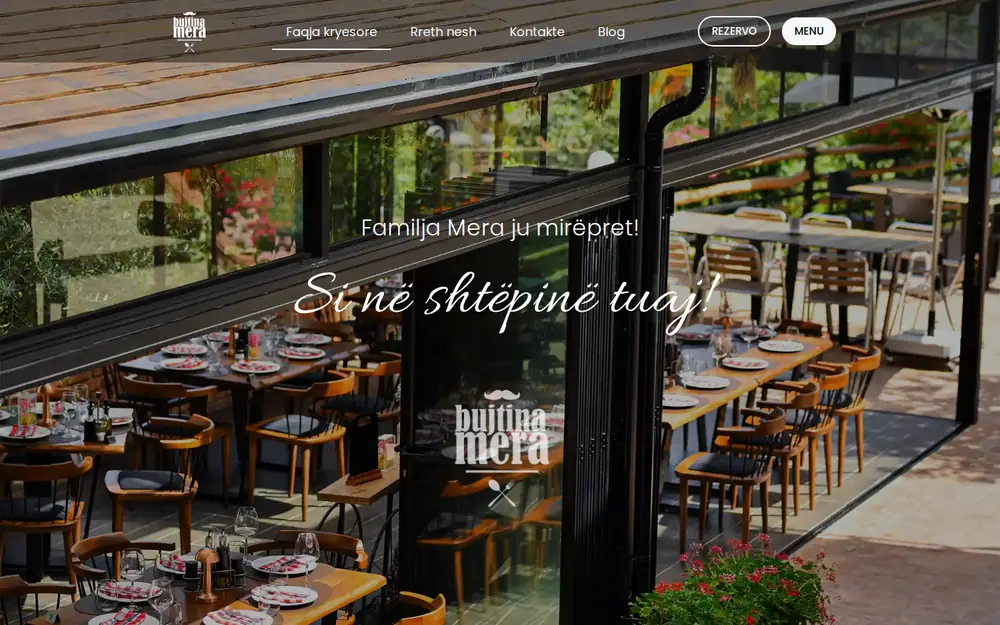
The way to answer it is the same whether the agency is local or overseas: look at live work and at how long clients stay. One example from our own portfolio is Bujtina Mera, a client we have worked with for over five years. We built their website with a custom design and still maintain it, alongside their social media, photography and printed materials.

Bujtina Mera restaurant website designed and maintained by BOS.al

Plenty of agencies can make something look impressive in a screenshot. Fewer build sites that load properly on a phone and still work years later, which is the part that matters to a small business owner footing the bill. So when you assess any agency, ask which clients have stayed with them longest, and test those sites yourself.

Other Real Risks of Outsourcing (And How to Avoid Them)

Quality aside, there are other risks worth knowing about, and every one of them can be managed with a bit of care upfront.

Miscommunication. If you and your designer are not on the same page, the final product will miss the mark. This is the second most common problem with overseas projects. Before you sign anything, have a video call with the team rather than relying on email alone. Pay attention to their English, how well they understand your requirements, and whether they ask thoughtful questions. A good overseas agency will communicate through whatever channel works for you: email, WhatsApp or Zoom. If they are hard to reach before you have paid, that is a preview of what happens after.

Payment disappearing. The nightmare scenario is paying a deposit and having the agency stop responding. It can happen with local agencies too, but it feels worse when your money has crossed a border. Never pay 100% upfront. A standard structure is a 30% deposit before work begins, 30% after the design mockup is approved, and 40% on completion. Any reputable agency will agree to milestone payments without pushback. Also check their track record on Clutch, Trustpilot or Google Reviews, ideally from clients in your own country.

Ownership of the website. Without a clear contract, you might be unable to access your own site’s files. Get a written contract stating that you own all design files, code and content on final payment, and that covers what happens if either side ends the project early.

Data security. If your website handles customer data through contact forms, payments or user accounts, the agency must take security seriously. Ask about GDPR compliance if you serve EU or UK customers, and about their general data practices. A professional agency hosts your site on reputable platforms, uses SSL and follows WordPress development best practices.

What to Look for in an Overseas Web Design Agency

A practical checklist that works whether you are hiring from Europe, Asia or Latin America:

  • Verified reviews on third-party platforms, not just testimonials on the agency’s own website. Clutch and Trustpilot are the most reliable, and reviews from clients in your own country carry the most weight.
  • Clear pricing. A trustworthy agency gives you a detailed quote, not a vague range, so you know exactly what is included: pages, revision rounds, mobile design, SEO basics and post-launch support.
  • A real team you can find on LinkedIn. A video call is the quickest way to confirm actual people work there.
  • Live sites, not just mockups. Visit what they have built, test it on your phone and run it through Google PageSpeed Insights. If their own website is slow, do not expect yours to be faster.
  • Fast responses before you have paid. Send an enquiry and time how long it takes to hear back.
  • Time zone overlap. An agency in Albania is one hour ahead of London and six hours ahead of New York, so there is plenty of overlap in business hours. From Australia, Albania is 8 to 10 hours behind Sydney depending on daylight saving. That still works: your late afternoon is their morning, so you can hold a short call before you finish for the day, and changes are usually ready when you start the next morning.

Five signs you should walk away:

  1. They ask for full payment upfront. Legitimate agencies split payments into milestones.
  2. They refuse a video call before you sign. If they will not talk before you have paid, they will not be available after.
  3. No written contract is offered. Without one you have no protection over code ownership, file access or termination terms.
  4. Their portfolio links are dead or slow. An agency that lets its own showcase rot will do the same to your site.
  5. They go quiet during initial contact. Response speed before payment is the best predictor of support after it.

Choosing the right partner is one of the most important decisions you will make. For more evaluation criteria, see our guide on how to choose a marketing agency.

How Much Can You Actually Save?

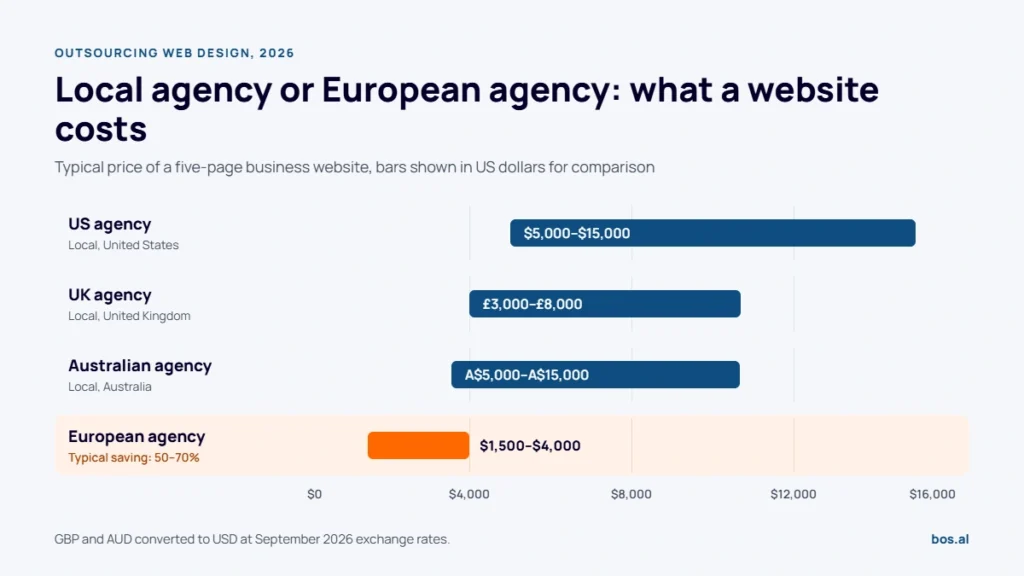
Website cost: local agency in the US $5,000–$15,000, UK £3,000–£8,000, Australia A$5,000–A$15,000, versus a European agency at $1,500–$4,000

Here is what a standard five-page business website typically costs in 2026:

Where you hireTypical price
Local agency in the US$5,000 to $15,000
Local agency in the UK£3,000 to £8,000
Local agency in AustraliaA$5,000 to A$15,000
European overseas agency$1,500 to $4,000 (£1,200 to £3,000)
Southeast Asia$800 to $2,500, with quality that varies widely

In competitive US markets like Tennessee, Nashville agencies routinely quote $8,000 to $12,000 for a standard business site. A European agency can deliver a comparable site for $1,500 to $3,500, a saving of $5,000 to $8,000 on one project. We break down those numbers in our page on web design for Tennessee businesses.

As a real example, these are our own package prices at BOS.al, with approximate conversions. Use them as a benchmark when you compare quotes from any agency:

PackageGBPUSD (approx.)AUD (approx.)Includes
Starterfrom £1,200from $1,600from A$2,2505 pages, SEO basics, mobile design, 3 months of support
Growthfrom £1,750from $2,350from A$3,30010 pages, blog, CMS, local SEO
Profrom £2,200from $2,950from A$4,150E-commerce, advanced SEO, custom animations

Full details are on our web design for small business UK page, and our guide on how much a website costs in the UK compares every option in detail.

Which option is best depends on your situation. European agencies suit businesses in the UK, EU and US East Coast that want a managed project with close working hours. If you are in Australia and want someone working your hours every day, remote staff in the Philippines or elsewhere in Asia may fit better, as long as you have time to manage them. Southeast Asian agencies are the cheapest route, but quality varies more, so the checks above matter even more there.

The Bottom Line

Hiring a web design team abroad is a sound financial decision for most small businesses, as long as you do the homework: verify reviews, insist on milestone payments, communicate clearly and test everything before paying in full.

Good web designers work everywhere. Where you hire matters less than how you check them: live work, verified reviews, a contract and milestone payments. Do those four things and the location becomes a question of price and working hours, not risk.

Key Takeaways

  • It is safe if you verify reviews on platforms like Clutch or Trustpilot, not just the agency’s own website.
  • Decide first whether you need remote staff you manage or an agency that delivers a finished project.
  • Never pay 100% upfront. Use milestones: 30% deposit, 30% after mockup approval, 40% on completion.
  • Overseas agencies typically cost 50 to 70% less than hiring locally in the US, UK or Australia, but the right region depends on your time zone and how much management you can take on.
  • Ask to see live websites, test them on your phone and have a video call before committing.

If you are comparing overseas agencies, you can test the sites in our portfolio the same way this guide suggests, or contact us for a quote.

Why Businesses Are Switching to Claude AI

switching to claude AI

There’s a moment every developer and enterprise team hits at some point. You’re deep in a project, you’ve got context in your head, and you need AI to help you move fast. So you type a short prompt into ChatGPT, and it confidently gives you an answer that’s half right, half invented, and entirely frustrating to untangle.

That moment is exactly why businesses are switching to Claude. Not because of a spec sheet. Because of what happens when AI understands you without needing you to explain everything.

AI Comparison

ChatGPT vs Claude AI: which performs better for business

✕ ChatGPT
  • ✕ Fills gaps with confident but inaccurate claims
  • ✕ Loses context on longer documents
  • ✕ Output almost always needs heavy editing
  • ✕ Inconsistent at enterprise scale
✓ Claude AI
  • ✓ Asks when unsure, with fewer fabrications
  • ✓ 200K tokens, keeps coherence across long documents
  • ✓ Brand-ready writing from the first draft
  • ✓ Safety and reliability at the core

AI should accelerate your work, not replace it.

Talk to us

The Real Problem With “Good Enough” AI

Let’s be honest. ChatGPT got a lot of teams started on their AI journey. But as enterprise teams have scaled their usage, in SaaS products, in e-commerce operations, in customer-facing workflows, a pattern keeps emerging. And it’s one we’ve been tracking closely as how AI is transforming modern business has shifted from a buzzword conversation to a day-to-day operational reality.

The hallucination tax is real.

When you don’t give ChatGPT every single detail it wants, it fills in the blanks. Not with “I’m not sure,” but with confident, fluent, completely fabricated information. For a developer building a pipeline or an engineer reviewing technical documentation, that’s not just annoying, it’s a liability. It’s also part of ChatGPT’s broader impact on content workflows that many enterprise teams are only now starting to fully reckon with.

One anonymized SaaS client I worked with was using AI to help generate internal technical summaries. The team kept noticing that ChatGPT would invent references, misattribute logic, and confidently describe system behavior that simply didn’t exist. Every output needed a human double-checking the work. The AI wasn’t accelerating anything. It was creating a second job.

This isn’t a niche complaint. It’s one of the top reasons enterprise teams are reevaluating their AI stack.

The “Aha Moment” That Changes Everything

Here’s the philosophy I’ve come to believe after working with these systems:

AI should accelerate your brain. Not replace it.

This isn’t just a philosophy about Claude, it speaks to the broader debate around AI replacing human work that’s playing out across every industry right now. The best AI doesn’t demand a perfectly crafted prompt with every nuance spelled out. It reads the room. It understands the core of what you’re asking, and it runs with it intelligently, without making up the rest.

That’s the difference you feel when you switch to Claude.

With Claude, you can give a short, precise answer and trust that the model understands the intent behind it. You’re not writing a legal contract every time you ask a question. You’re having a working conversation with something that actually comprehends context.

For enterprise teams where time is the most expensive resource, this is a meaningful shift. You stop babysitting prompts. You start getting real work done.

What Engineers and Developers Actually Notice

1. It Doesn’t Invent What It Doesn’t Know

This sounds like a low bar, but in practice it’s transformative. Claude is far more likely to tell you when it doesn’t have enough information, and to ask a clarifying question, than to fabricate a plausible-sounding answer. For technical teams, this alone is worth the switch.

2. The Long Context Window Changes How You Work

One of the most practical differences for engineering teams is Claude’s ability to hold an enormous amount of context without losing the thread. You can feed in an entire codebase, a lengthy API specification, a 50-page product document, and Claude stays coherent throughout.

I’ve seen e-commerce teams feed in full product catalogs and customer service histories and get outputs that actually reflect the complexity of the data. No truncation, no “I couldn’t process the full document.” Just coherent, useful responses.

ChatGPT’s shorter and less reliable context handling means teams often have to chunk their work artificially, which defeats the purpose of AI-assisted workflows in the first place.

3. The Writing Quality Doesn’t Sound Like AI

This matters more than people expect, especially in customer – facing SaaS and e – commerce contexts. Claude’s outputs are notably more natural, more nuanced, and more adaptable to a specific tone or brand voice.

One anonymized e-commerce client switched after realizing that every piece of content coming out of their AI pipeline required heavy editing before it could go live. With Claude, the first draft was usable. The voice held up. The tone matched their brand without needing a dozen rounds of “make this sound less robotic.”

For enterprise teams processing high volumes of content, product descriptions, support responses, internal documentation, this isn’t a nice-to-have. It’s an operational advantage.

The Enterprise Trust Factor

There’s also a less-discussed dimension to this shift: trust in the company behind the model.

Anthropic has been deliberate and public about building AI systems with safety and reliability at the core. For enterprise decision-makers, especially in regulated industries, or those handling sensitive customer data, this matters when making long-term infrastructure decisions.

Choosing an AI partner isn’t just about what works today. It’s about who you trust to be responsible as these systems become more deeply embedded in your operations.

A Quick Comparison That Puts It in Context

What Teams ExperienceChatGPTClaude
Short, contextual promptsOften hallucinates gapsUnderstands intent, asks when unsure
Long document processingContext drops offStays coherent across large inputs
Brand-consistent writingRequires heavy editingNatural, adaptable tone out of the box
Technical accuracyConfident but sometimes fabricatedMore reliable, flags uncertainty
Enterprise-grade reliabilityInconsistent at scaleDesigned with safety as a foundation

Who Should Pay Attention to This

If you’re an enterprise decision-maker in a SaaS or e – commerce environment and you’re still on the default AI stack you adopted two years ago, it’s worth asking whether that stack is still earning its place.

The question isn’t whether AI is useful. You already know it is. The question is whether the AI you’re using is genuinely accelerating your team, or quietly creating overhead you’ve just learned to live with.

The teams I’ve seen make the switch to Claude don’t usually go back. Not because of a feature list, but because working with an AI that actually understands you, without needing you to over-explain everything, feels fundamentally different.

Try It Yourself

The best way to understand the difference is to experience it. Claude is available directly at claude.ai, no complex setup required. Give it the same short, real – world prompt you’ve been giving your current AI. See what happens when you don’t have to spell out every detail.

Your team’s time is the most valuable thing you have. AI should be accelerating it.

Written from the perspective of a developer who builds with these tools – not a marketing department.

Will ChatGPT Replace SEO

chatgpt replace seo

No. ChatGPT and other AI tools will not replace SEO as a profession or as a business function. They change how SEO is done, not whether it is needed. SEO is still required to earn visibility, trust and long-term traffic in Google and AI-driven search experiences.

This still depends on the same fundamentals explained in our guide on how to rank higher on Google, where strategy, structure and authority matter more than tools.

What Actually Changed After AI Entered Search

The most visible change since AI became mainstream is how people search. Queries are no longer short or mechanical. They are conversational, contextual and question-driven.

This didn’t eliminate keywords. It exposed intent.

Google has always tried to understand what users want. AI simply accelerated this process by changing user expectations. The clearest example of this today is Google AI Mode, a direct shift in how Google presents search results using AI-generated answers.

As a result, pages that exist only to “target a keyword” are slowly losing visibility. Pages that explain, compare and answer questions thoroughly are gaining it.

This is SEO working as intended.

Why the “SEO Is Dead” Narrative Failed

The panic around AI replacing SEO came from a misunderstanding of what SEO actually is. We’ve seen the same fear pattern before with new technologies, including AI-driven development tools, which we explored when asking whether innovation actually means replacement in this analysis of Google Antigravity and the future of coding. Many assumed that if AI can write content, then SEO becomes irrelevant.

But SEO was never just about writing.

Real SEO involves:

  • Understanding how users think and search
  • Translating that intent into structured, crawlable content
  • Building authority over time in a way Google can trust

AI can generate text, but it cannot evaluate market nuance, user psychology or long-term strategic risk. Those decisions still require experience.

This is also where backlinks were misunderstood. Backlinks didn’t lose value, but Google became far better at detecting why a link exists. Links without intent or relevance stopped working. Legitimate endorsements did not.

A Real-World Example That Still Works Today

A car rental website we worked on was buried deep in Google results. The owners spent heavily on ads, but ads didn’t solve the core problem: Google did not trust the site enough to rank it organically.

The SEO work focused on fundamentals:

  • Clarifying pages so users and search engines understood them
  • Publishing consistent, useful blog content
  • Earning backlinks that made sense contextually

Within three months, the website ranked first for its main keyword and top five for several secondary keywords. More importantly, it started generating consistent organic calls every month.

This happened while AI tools were widely available.

SEO didn’t stop working. Poor SEO did.

Where AI Helps, and Where It Fails

We use AI tools daily. They are valuable for speeding up workflows, organizing ideas and helping turn expertise into structured content.

What AI does not replace is judgment.

Google updates continuously. Even if AI becomes better at generating content, Google simultaneously becomes better at detecting low-value output. That creates a permanent gap between automation and trust.

When businesses rely entirely on AI-generated content, they often see fast rankings followed by sharp drops.

AI works best as an assistant to an expert, not as the expert itself.

Why Google Is Moving Toward Expertise, Not Volume

Google does not need more content. It already has more information than users can consume.

What it needs is confidence.

That confidence comes from:

  • Demonstrated experience
  • Real examples and case studies
  • Clear explanations instead of recycled summaries

This is especially true in smaller or local markets, where trust and relevance matter more than sheer output. AI-only strategies tend to fail faster in these environments.

SEO today rewards clarity, accountability and experience, not speed.

The Reality of Backlinks Today

Backlinks are harder to earn and less forgiving than before. Their value now depends heavily on intent.

Google evaluates whether a link:

  • Makes sense contextually
  • Exists for users, not manipulation
  • Comes from a site with its own credibility

This doesn’t mean backlinks are weak. It means they require strategy. The volume-driven link-building era is over, but authority-driven linking is still very much alive.

Why SEO Is Still a Full-Time Job

When AI first emerged, it was reasonable to question whether SEO would become a part-time role.

What actually happened is the opposite.

SEO now requires more expertise because mistakes are punished faster. Google doesn’t want raw information. It wants professionals who understand how to present information responsibly and effectively.

SEO didn’t shrink. It matured.

Summary

  • ChatGPT does not replace SEO. It removes outdated SEO practices.
  • Search behavior shifted toward questions, not away from search engines.
  • AI speeds up execution but cannot replace judgment or strategy.
  • Google increasingly rewards expertise, experience and trust.
  • SEO remains essential for long-term, stable visibility.

How to Optimize Google Business Profile in Albania?

optimize google business

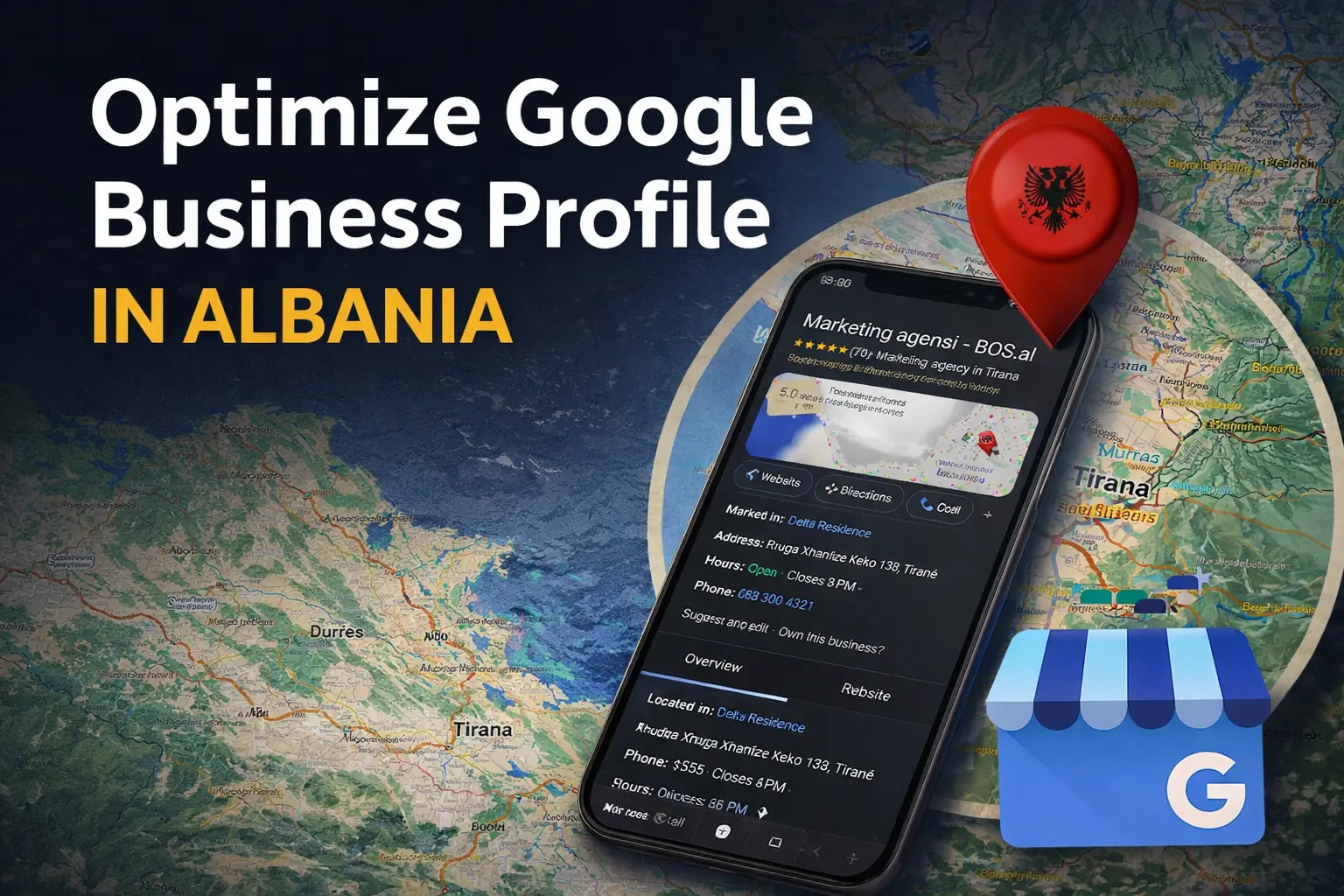
To optimize a Google Business Profile (formerly Google My Business) in Albania, start with the basics: a clean business name, the right spot on the map, the right main category and a full list of your services. Then keep the profile active with real photos, regular posts and new reviews. Google decides who shows up in Maps using three things: how well your profile matches the search, how close you are to the person searching, and how well known your business is online. You can’t change your location, but you can work on the other two. Small fixes often show results in a few weeks. In busy categories in Tirana or Durrës, it can take a few months.

A complete profile also makes people trust you more. Research by Google and Ipsos found that people are 2.7 times more likely to see a business as trustworthy when its profile is complete. They are also 70% more likely to visit it and 50% more likely to think about buying from it.

At BOS we have worked on profiles for car rentals, clinics, restaurants, hosting companies, online shops and real estate agencies. Most of them weren’t missing one big secret. They had five to ten small problems holding them back. Here is the approach we use, made for how things work in Albania: names in two languages, unclear addresses, a lot of competition in Tirana and Durrës, and customers who call first and then message on WhatsApp or Instagram.

Why it’s harder in Tirana and Durrës

Tirana and Durrës have the most businesses and the most searches in the country. You can do everything “okay” there and still end up in places 5 to 10. Small details decide who gets the top three spots: categories, a consistent name, service descriptions, photos, how often you post and the service pages on your website. According to Whitespark’s Local Search Ranking Factors survey, the profile counts for about 32% of what decides the top three in Maps. That’s a lot, but it’s still only one part of local SEO for a small business.

In Albania, most customers still call before they buy. So don’t judge your profile by how many people see it. Judge it by how many people call.

Step 1: Fix the common Albanian problems first

Business name: keep it simple and the same everywhere

The most common problem we see is a messy business name. Usually it looks like one of these:

  • Services or city names added to the business name
  • Albanian and English mixed in different ways on Google, the website and the shop sign

Your Google Business Profile name should be the same as your real name: the one on your sign, your website and your invoices. Adding keywords to the name is against Google’s rules and can get your profile suspended. If your brand uses two languages, use both everywhere. If it doesn’t, don’t add them.

Address and map pin

Finding places on a map in Albania can be hard. Street names are often unclear, many addresses use the “lagje”, buildings are shared and pins end up in the wrong place.

  • Put the pin right on your entrance, or as close as you can.
  • Write your address the same way everywhere, and don’t keep changing it.
  • If you share a building, add the floor, the unit or a well-known landmark.

A correct pin helps your ranking. It also means more people ask for directions and fewer get lost.

Step 2: Categories and services

If your profile isn’t moving, categories are often the quickest fix.

Main category

Pick the category for the service that makes you the most money. Don’t pick the widest one or the one that sounds best. Your main category decides which searches you can show up for at all.

Extra categories

Only add categories that really describe what you do. Adding too many makes your profile less clear to Google.

Services list

Think of this list as a small page about what you sell. Write services the way customers search for them, like “same day”, “emergency” or “in Tirana”. In busy cities, start with easier searches that fewer people use. They usually bring your first results, and those help you move up for harder searches later.

Description

You get 750 characters. Say what you do, where you work and who you work with, in simple words. A list of keywords is not a description.

Step 3: Photos and posts

Many businesses in Albania set up their Google Business Profile once and never touch it again. That’s how you get ahead of them.

Photos

Good photos make people trust you fast. They often bring more calls even before your ranking goes up. Upload real, recent photos of:

  • The outside, so people can find you
  • The inside, or how you work
  • Your team
  • Your finished work, or before and after results

Posts

One or two posts a week is enough for most businesses. If your category is very busy, post three times a week for the first month.

“The whole point of GBP is to be active and consistent with your updates and posts,” says Tomas, SEO Specialist at BOS.

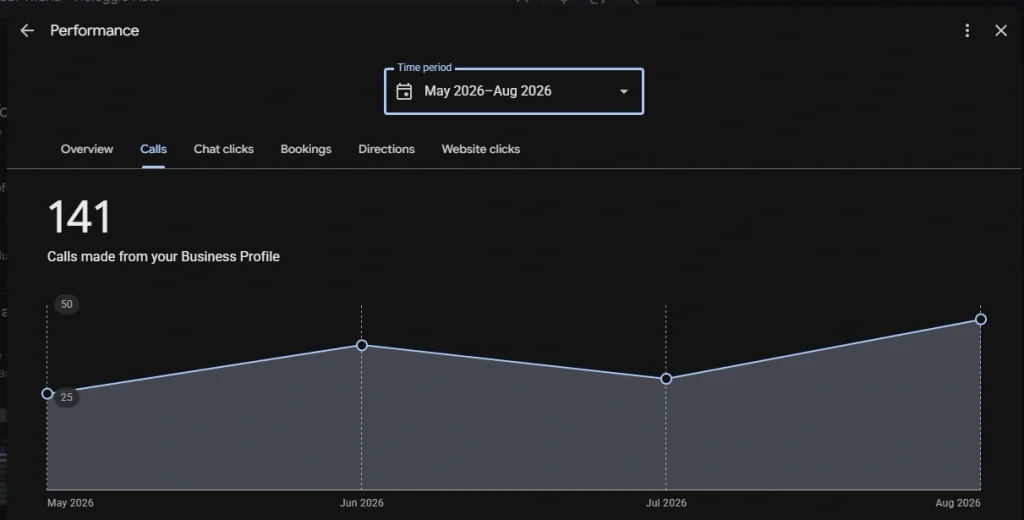
Here is one example. A small business was not showing near the top of Maps. We posted three times a week at first, fixed wording that confused Google about what they do, added better categories and set up the profile for that type of business. In three months, calls from the profile almost doubled: from about 25 in May to about 45 in August, with a small drop in July. With calls from the website added, the owner now gets 3 to 5 calls a day. The profile grew because Google could see it was relevant and active.

oogle Business Profile Performance report showing calls rising from May to August

Step 4: Reviews that fit how Albanians buy

Most owners here want only five-star reviews. But a profile that looks too perfect can seem fake. A few neutral or even bad reviews show you are a real business that is growing.

What matters most:

  • Get real reviews often, not all at once.
  • Reply politely to every review, good or bad.
  • Use a bad review to show how you fix problems. Don’t try to remove it.

Google doesn’t allow you to pay for reviews, give discounts for them or ask only happy customers. A simple routine that fits how people here use calls and WhatsApp works better:

  1. Finish the job.
  2. Ask for a review the same day.
  3. Send the review link on WhatsApp.
  4. Thank the customer after they post it.

Step 5: Get ready for AI answers in Maps and Search

In November 2025, Google removed the Q&A section from Google Business Profiles. It is being replaced by AI answers, called Ask Maps, which Google is slowly rolling out, starting in the US. Instead of reading old questions, people ask Google directly and get an answer made from your profile, your reviews and your website.

So the answers customers need should be in three places:

  • On your website. Answer the questions people ask before they call: prices or price ranges, areas you cover, opening hours and how long a job takes. One page for each service works better than one general page. The same pages also help you appear in AI search results outside Maps.
  • In your reviews. Reviews that name the service and the city give Google’s AI more to work with.
  • On your other listings. Use the same name, address and phone number on Bing Places, Apple Business Connect, Facebook and local directories. AI tools like ChatGPT also read sources outside Google.

Step 6: Your website decides how fast results come

How fast you see results depends on three things:

  • Your type of business
  • How much competition there is in your city
  • How many good service pages your website has

With only a homepage or very little content, it takes longer. With one good page for each service, matching the services on your profile, results come much faster. Many businesses here use only Instagram, but a website gives Google much more to work with than an Instagram page, and you can see the difference in Maps.

That’s why we don’t promise fast results. Growth usually takes time, and the businesses that win are the ones that keep going.

Free tools to track your results

You don’t need to pay for tools to start:

  • Business Profile Performance shows what people searched to find you, and how many called, asked for directions or visited your website.
  • Google Search Console shows which searches bring people to your website, so you can add the services people actually look for.
  • Google Analytics 4 shows how many visits and leads come from Maps, once you add a tracking link to the website button on your profile.

Common problems we fix

Duplicate listings

Two profiles for the same business confuse Google and split your reviews and trust. Merging or removing the extra one often helps a lot.

Keyword stuffing

Too many keywords in the name or description can get your profile into trouble. Put keywords in your services, posts and website, not in your business name.

Going only after hard searches

Win the easier searches from people ready to buy first. Then move on to the harder ones.

A 30-day plan

Week 1: The basics

Fix the name, choose your categories, fix the address and pin, fill in your services and business details, and remove duplicates.

Week 2: Trust

Start asking for reviews and upload good photos: outside, inside or how you work, your team and examples of your work.

Week 3: Stay active

Post once or twice a week, or three times if your category is very busy. Rewrite your service descriptions using the words customers really search for.

Week 4: Grow

Add or improve the service pages on your website and answer common customer questions there. Track calls, direction requests and clicks, and do more of what brings real customers.

In short

  • Fix your name, the language you use in it and your map pin first. These are the biggest problems in Albania.
  • Choose the right categories, then go after easy searches from ready-to-buy customers before the hard ones.
  • Keep your profile active with photos, posts and real reviews.
  • Now that Q&A is gone, your website and reviews answer customer questions for Google’s AI.

If your profile is stuck and you want someone to look at it, our SEO team can check it and tell you what’s holding it back.

How to Write a Motivation Letter That Actually Gets Read (+ Free Template 2026)

how do i write a motivation letter

TL;DR: A motivation letter is not a formality — it’s often the document that decides whether you get an interview. Keep it to one page, base it on a real achievement, and tailor it to every single application. Download the free Word template below, fill in the brackets, and you’re ready.

Motivation Letter Template 2026 — BOS.al
Professional template ready to fill in   DOCX Free
Download Word

What a motivation letter actually is

A motivation letter is one of the most misunderstood documents in the job application process. Most people treat it as optional — something to dash off quickly before attaching their CV. But in practice, the motivation letter often has more impact than the CV itself.

The reason is straightforward: CVs have become almost identical. Same structure, same bullet points, same action verbs. The motivation letter is the only place in an application where you can show your personality, the way you think, and the specific value you bring to this role at this company.

It is not a summary of your CV. It doesn’t exist to list your qualifications — those are already on the page. It exists to answer one question the recruiter is silently asking: why should I spend 30 minutes interviewing this person? If you haven’t already got your CV in shape, start there first — our guide on how to write a CV for a job covers everything you need before writing your motivation letter.

The biggest mistake people make in 2026

Using AI to write the entire letter from scratch. It’s the most common mistake and one of the most damaging.

Recruiters see hundreds of applications. They have learned to spot AI-generated letters instantly — the language is too polished, too generic, too interchangeable. When every letter sounds the same, none of them stands out. And if your motivation letter is indistinguishable from the other 200 applications, it defeats its entire purpose.

That does not mean you can’t use AI tools at all. Use them to improve your structure, sharpen your phrasing, or fix grammar — but the core of the letter, the story, the specific achievement, the reason you want this job at this company, has to come from you. A recruiter reading your letter should feel like they’re hearing from a real person.

What recruiters are actually looking for

Recruiters are not reading motivation letters to verify your qualifications. They already have your CV for that. What they want to understand from your letter is:

  • Whether you can communicate clearly and directly
  • How you handle challenges and pressure
  • Whether you’ve done any research into the company or role
  • Why this position, at this company, at this point in your career

The last point is the one most people skip. A letter that could have been sent to any company is a letter that will be ignored by every company.

The right structure — 4 paragraphs, nothing more

There is no universal formula, but this structure works for the vast majority of applications:

Paragraph 1 — Opening: Who you are, which role you’re applying for, and one specific reason this company interests you. Avoid “I am writing with great interest” — say something that shows you know who they are.

Paragraph 2 — Your key achievement: Choose one real moment from your career — a project, a result, a challenge you solved — and describe it with a concrete number. This is the paragraph that separates good letters from forgettable ones.

Paragraph 3 — Why this company: Show that you’ve done your research. Reference something specific — their work, their values, their approach. Not “a dynamic and innovative company.”

Paragraph 4 — Close with a call to action: Ask for the interview directly. “I would welcome the opportunity to discuss how I can contribute” is enough. Don’t leave it vague.

Click & type Fill in your details, then download as PDF
Anna Beck
Digital Marketing Specialist
anna.beck@gmail.com
+44 7700 900123
London, UK
London, 16 April 2026
Dear [Recruiter’s Name],
I am writing to express my interest in the Digital Marketing Specialist position at ABC Solutions. With four years of experience managing paid campaigns, SEO, and social media for small and medium businesses, I am confident I can make a meaningful contribution to your team.
In my role as Marketing Specialist at DigiMedia Agency, I grew organic traffic for our clients by an average of 80% over six months through a combined SEO and content strategy. Alongside this I managed Meta Ads campaigns with budgets up to £2,500 per month, reducing cost-per-click by 30% compared to the previous period. That experience taught me to balance strategic thinking with hands-on, data-driven work.
I am particularly drawn to ABC Solutions because of your results-led approach and the collaborative culture I have seen reflected in your work. The way I approach problems — carefully, with open communication and a focus on outcomes — I believe fits naturally with how your team operates.
I would welcome the chance to discuss how I can contribute. I am available for an interview at any time that suits you.
Thank you for your time and consideration.

Yours sincerely,
Anna Beck

Sample data shown — replace with your own details before downloading.

A filled-in example

Below is the same example included in the Word template — written out in full so you can see what a strong letter looks like before you write your own:

Anna Beck London, UK | anna.beck@gmail.com | +44 7700 900123

Dear [Recruiter’s Name],

I am writing to express my interest in the Digital Marketing Specialist position at ABC Solutions. With four years of experience managing paid campaigns, SEO, and social media for small and medium businesses, I am confident I can make a meaningful contribution to your team.

In my role as Marketing Specialist at DigiMedia Agency, I grew organic traffic for our clients by an average of 80% over six months through a combined SEO and content strategy. Alongside this I managed Meta Ads campaigns with budgets up to £2,500 per month, reducing cost-per-click by 30% compared to the previous period. That experience taught me to balance strategic thinking with the kind of hands-on, data-driven work that actually moves numbers.

I am particularly drawn to ABC Solutions because of your results-led approach and the collaborative culture I have seen reflected in your work. The way I approach problems — carefully, with open communication and a focus on outcomes — I believe fits naturally with how your team operates.

I would welcome the chance to discuss how I can contribute. I am available for an interview at any time that suits you.

Thank you for your time.

Yours sincerely, Anna Beck

Motivation letter for a job vs. for university

The structure above works for job applications. For university or scholarship applications, the emphasis shifts:

For jobs, recruiters want to see results — what you achieved, measured where possible. For universities, admissions teams want to understand your potential, your academic motivation, and where you want to go. Past achievements still matter, but your reasoning and future goals carry more weight.

The one thing that applies to both: specificity. Generic letters are rejected in both contexts.

Don’t overlook how you send it

The letter itself is only half the picture. Most motivation letters are sent by email — and the email presentation matters just as much as the letter attached to it.

This means a clear subject line, a professional opening, and an email address that uses your name. If you are still using an old personal address, set up a professional email account before you start applying — it is the first thing a recruiter sees before they open your attachment.

This becomes especially important when applying for remote or work-from-home roles, where the email and motivation letter are often the only contact you have with a potential employer before an interview — there is no in-person impression to fall back on.

Key Takeaways

  • The motivation letter often matters more than the CV — it shows who you are, not just what you’ve done
  • One real achievement with a number beats three paragraphs of vague description every time
  • One page, four paragraphs — if you need more, you’re saying too much
  • Tailor it to every application — a generic letter is a wasted opportunity
  • Don’t use AI to write the whole thing — recruiters spot it immediately, and it defeats the purpose
  • Download the free Word template above — fill in the brackets and you have a professional starting point

Will Web Design Be Replaced by AI?

will web design be replaces by ai

Short Summary: AI can produce a website, but not your website. After testing multiple tools and seeing how clients respond to them, the gap between AI output and a real business site is still significant. The role of AI in web design is to support the process, not lead it.

AI is changing everything. It writes content, generates images, and promises to build websites in minutes. Because of this, many business owners and designers are asking the same question.

From working with real clients, especially local businesses in Albania such as car rentals, clinics, and pharmacies, and from personally testing many AI tools, one thing has become very clear: the conversation is much more nuanced than a simple yes or no.

My Experience Using AI in Web Design

I’ve tried many AI – powered web design tools. Some looked impressive at first, but once I used them in real projects, the limitations showed quickly. The designs were often generic, the structure weak, and the homepage rarely matched what I had in mind.

This is very different from how we approach projects in our professional web design services, where every layout is built around business goals, user intent, and long-term performance.

A few AI tools came close, but even then, they didn’t deliver the feeling or clarity a real business needs. In practice, AI helped me generate ideas or create a basic starting point, but never a complete, client – ready website.

What Happens When Clients Try AI Themselves

Most of my clients already know that AI isn’t ready to replace web designers. The interesting part is what happens when someone has doubts.

After trying AI website builders on their own, almost all of them change their perspective. They see that AI can produce a website, but not their website. The result often lacks trust, personality, and direction – especially for small and local businesses.

This is something we see often when working on web design for small businesses, where strategy matters more than templates.

Why Local Businesses Are Different

Local businesses don’t just need something that looks modern. They need a website that communicates trust, explains services clearly, and encourages real action.

Visibility on Google, especially for local searches, is critical. That’s why web design and local SEO strategy must work together.

AI doesn’t understand local competition, customer psychology, or how different industries should feel online. A clinic, a pharmacy, and a car rental business may all use websites, but they should never feel the same.

The Practical Role of AI in My Workflow

In real projects, I use AI mainly to explore ideas or get unstuck at the beginning. It can suggest layouts or basic structures that help speed up the process.

However, decisions about user experience, design flow, content hierarchy, and SEO are still made manually. This is especially important when working on SEO – focused websites, where structure and intent directly affect rankings.

AI supports the work, but it doesn’t define it.

User Experience Is Still Human

User experience goes beyond layout and colors. It’s about emotion, trust, and intuition.

AI doesn’t feel whether a design is calming or stressful. It doesn’t sense whether a page builds confidence or creates doubt. These are the same reasons why graphic design and branding still require human creativity.

SEO, UX, and the Importance of Human Control

SEO today is closely connected to user experience. Structure, clarity, speed, and intent matter more than ever.

AI can help accelerate parts of the process, but relying on it without critical thinking is risky. This is why many businesses still ask whether SEO services are worth it, even in the age of AI.

Using AI responsibly means keeping human decision-making at the center.

Where This Leaves Web Designers

AI is raising expectations. It’s making average work easier to produce, which also means average work stands out less.

The same shift is happening across digital marketing, including AI – powered agencies and tools that promise full automation.

Designers who understand strategy, users, and business goals, and who know how to use AI intelligently – are becoming more valuable, not less.

A Thought to Leave You With

AI is advancing fast, and tools like Google’s experimental systems show how powerful it can become. Some even ask whether we are approaching “the end of coding”.

But websites still exist to communicate with humans.

As long as trust, emotion, and real business goals matter, human thinking will remain part of web design. The real shift isn’t replacement, it’s evolution.

Key Takeaways

  • AI website builders produce generic results that rarely match a real business’s needs for trust and clarity
  • Local businesses in particular need design decisions built around specific industries, audiences, and goals
  • User experience depends on emotion and judgment, which are still outside what AI tools can reliably handle
  • AI is useful for generating starting points and speeding up early-stage work, not for replacing human decision-making
  • Designers who understand strategy and use AI as a tool are more valuable now than before