
Quick Summary: Outsourcing web design overseas usually saves 50 to 70% compared with a local agency. A five-page business site costs $1,500 to $4,000 with a European agency, versus $5,000 to $15,000 locally. It is safe if you verify reviews, pay in milestones and hold a video call before signing anything.
You need a website for your business, but every local agency you have contacted wants $6,000 to $15,000. In Australia the quotes look similar, often A$5,000 to A$15,000 for a small business site. Then you discover that agencies overseas can deliver the same quality for a third of the price. It sounds too good to be true, and that is exactly what makes you hesitate.
Sending money to an agency in another country raises real questions: what happens if they disappear halfway through the project, or hand back something that looks nothing like what you asked for?
Those are fair concerns, and the honest answer is that hiring an overseas team is safe, but only if you know what to look for and what to avoid. This guide walks through everything you need to know before hiring an offshore web design agency, based on real experience from both sides of the arrangement.
Why So Many Businesses Are Outsourcing Web Design
Roughly two-thirds of US companies outsource at least one department, and web design is one of the fastest-growing categories. The reason is not just about saving money, although that certainly helps.
Small businesses in the US, UK and Australia face the same problem: local web design agencies price their services based on local salaries, office rent and overhead. A small agency in London, New York or Sydney might charge £5,000, $8,000 or A$10,000 for a basic five-page business website. Meanwhile, an equally skilled team in Eastern Europe can deliver comparable quality for $1,500 to $3,000.
The gap is not about talent. It is about the cost of living in different parts of the world. A senior web designer in Tirana, Albania earns a competitive local salary while charging clients far less than their counterpart in Manhattan or Melbourne.
This is why outsourcing is no longer just for large corporations. Startups, local service businesses, restaurants, tradespeople and e-commerce brands are all discovering that they can get professional websites built overseas without breaking the bank.
Remote Staff or Overseas Agency? Two Ways to Outsource
Before comparing providers, decide which model you actually need. Most search results mix them together, but they solve different problems.
| Hire remote staff | Hire an overseas agency | |
|---|---|---|
| How it works | A dedicated designer or developer works for you, usually through a staffing company | An agency delivers a finished project for a fixed price |
| Common locations | Philippines, India, Latin America | Eastern Europe and the Balkans (Albania, Poland, Romania) |
| Pricing | Hourly or monthly fee per person | Fixed project price, agreed upfront |
| Who manages the work | You do | The agency does |
| Skills you get | One person | Designer, developer and SEO in one team |
| Best for | Ongoing tasks when you already have someone to manage them | One website project with a clear scope and no in-house tech lead |
| Main risk | Training, turnover and management time | Choosing the wrong agency (covered below) |
If you want a person to add to your team long term, remote staff makes sense. If you want a finished website without managing anyone, an agency is the better fit. The rest of this guide focuses on hiring an agency.
The Biggest Concern: “Will the Quality Be Good Enough?”
We run a web design agency in Tirana, Albania. When businesses consider an agency abroad, the question we hear most is not about payment security or time zones. It is about quality.
That is a fair question. Many business owners have been burned before. They hired a cheap freelancer or another agency and got a website that looked amateur, loaded slowly, or simply did not represent their business well, and that experience makes them cautious about trying again with someone overseas.
The way to answer it is the same whether the agency is local or overseas: look at live work and at how long clients stay. One example from our own portfolio is Bujtina Mera, a client we have worked with for over five years. We built their website with a custom design and still maintain it, alongside their social media, photography and printed materials.
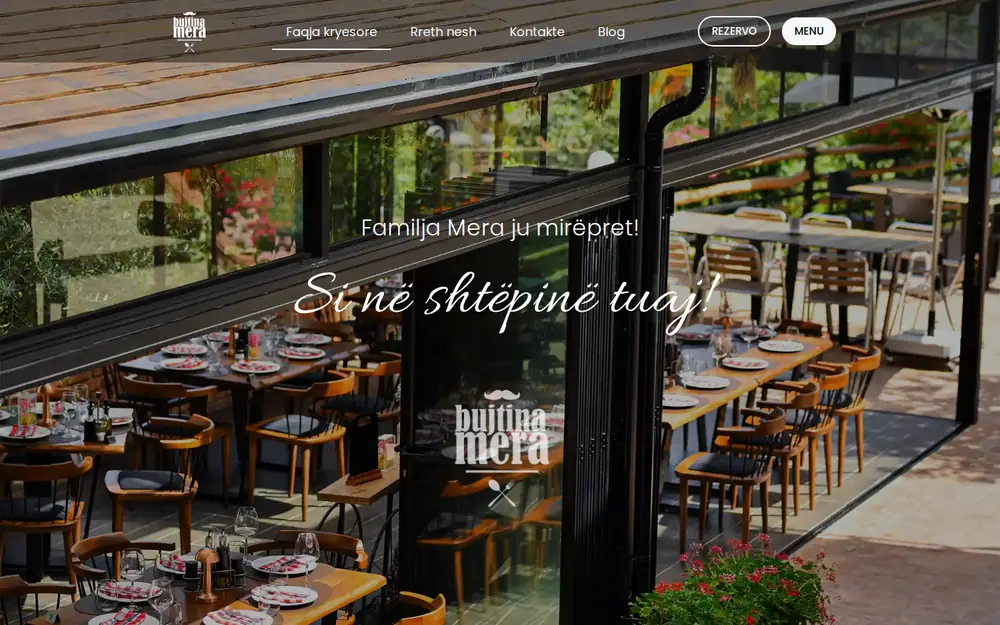
Plenty of agencies can make something look impressive in a screenshot. Fewer build sites that load properly on a phone and still work years later, which is the part that matters to a small business owner footing the bill. So when you assess any agency, ask which clients have stayed with them longest, and test those sites yourself.
Other Real Risks of Outsourcing (And How to Avoid Them)
Quality aside, there are other risks worth knowing about, and every one of them can be managed with a bit of care upfront.
Miscommunication. If you and your designer are not on the same page, the final product will miss the mark. This is the second most common problem with overseas projects. Before you sign anything, have a video call with the team rather than relying on email alone. Pay attention to their English, how well they understand your requirements, and whether they ask thoughtful questions. A good overseas agency will communicate through whatever channel works for you: email, WhatsApp or Zoom. If they are hard to reach before you have paid, that is a preview of what happens after.
Payment disappearing. The nightmare scenario is paying a deposit and having the agency stop responding. It can happen with local agencies too, but it feels worse when your money has crossed a border. Never pay 100% upfront. A standard structure is a 30% deposit before work begins, 30% after the design mockup is approved, and 40% on completion. Any reputable agency will agree to milestone payments without pushback. Also check their track record on Clutch, Trustpilot or Google Reviews, ideally from clients in your own country.
Ownership of the website. Without a clear contract, you might be unable to access your own site’s files. Get a written contract stating that you own all design files, code and content on final payment, and that covers what happens if either side ends the project early.
Data security. If your website handles customer data through contact forms, payments or user accounts, the agency must take security seriously. Ask about GDPR compliance if you serve EU or UK customers, and about their general data practices. A professional agency hosts your site on reputable platforms, uses SSL and follows WordPress development best practices.
What to Look for in an Overseas Web Design Agency
A practical checklist that works whether you are hiring from Europe, Asia or Latin America:
- Verified reviews on third-party platforms, not just testimonials on the agency’s own website. Clutch and Trustpilot are the most reliable, and reviews from clients in your own country carry the most weight.
- Clear pricing. A trustworthy agency gives you a detailed quote, not a vague range, so you know exactly what is included: pages, revision rounds, mobile design, SEO basics and post-launch support.
- A real team you can find on LinkedIn. A video call is the quickest way to confirm actual people work there.
- Live sites, not just mockups. Visit what they have built, test it on your phone and run it through Google PageSpeed Insights. If their own website is slow, do not expect yours to be faster.
- Fast responses before you have paid. Send an enquiry and time how long it takes to hear back.
- Time zone overlap. An agency in Albania is one hour ahead of London and six hours ahead of New York, so there is plenty of overlap in business hours. From Australia, Albania is 8 to 10 hours behind Sydney depending on daylight saving. That still works: your late afternoon is their morning, so you can hold a short call before you finish for the day, and changes are usually ready when you start the next morning.
Five signs you should walk away:
- They ask for full payment upfront. Legitimate agencies split payments into milestones.
- They refuse a video call before you sign. If they will not talk before you have paid, they will not be available after.
- No written contract is offered. Without one you have no protection over code ownership, file access or termination terms.
- Their portfolio links are dead or slow. An agency that lets its own showcase rot will do the same to your site.
- They go quiet during initial contact. Response speed before payment is the best predictor of support after it.
Choosing the right partner is one of the most important decisions you will make. For more evaluation criteria, see our guide on how to choose a marketing agency.
How Much Can You Actually Save?
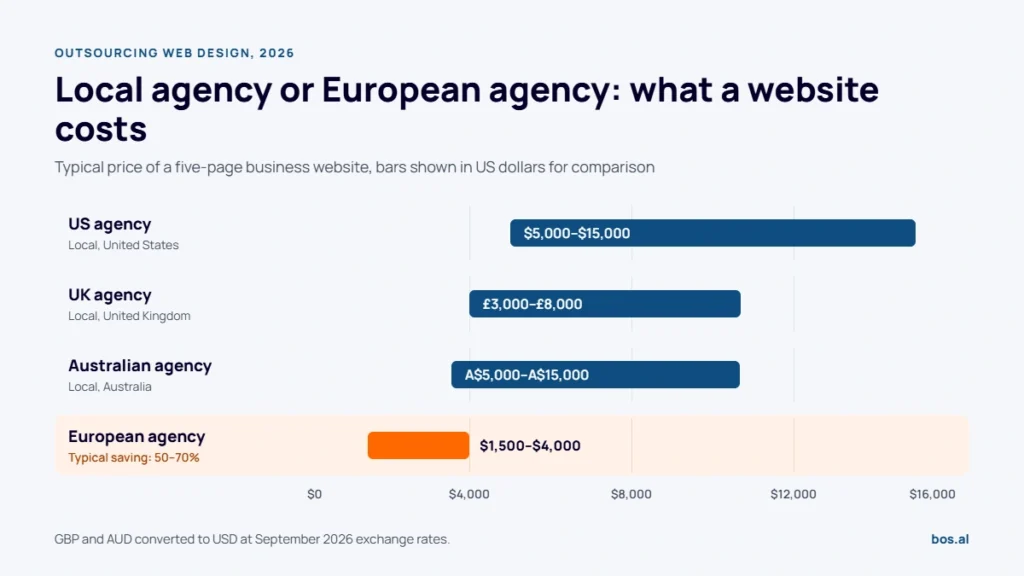
Here is what a standard five-page business website typically costs in 2026:
| Where you hire | Typical price |
|---|---|
| Local agency in the US | $5,000 to $15,000 |
| Local agency in the UK | £3,000 to £8,000 |
| Local agency in Australia | A$5,000 to A$15,000 |
| European overseas agency | $1,500 to $4,000 (£1,200 to £3,000) |
| Southeast Asia | $800 to $2,500, with quality that varies widely |
In competitive US markets like Tennessee, Nashville agencies routinely quote $8,000 to $12,000 for a standard business site. A European agency can deliver a comparable site for $1,500 to $3,500, a saving of $5,000 to $8,000 on one project. We break down those numbers in our page on web design for Tennessee businesses.
As a real example, these are our own package prices at BOS.al, with approximate conversions. Use them as a benchmark when you compare quotes from any agency:
| Package | GBP | USD (approx.) | AUD (approx.) | Includes |
|---|---|---|---|---|
| Starter | from £1,200 | from $1,600 | from A$2,250 | 5 pages, SEO basics, mobile design, 3 months of support |
| Growth | from £1,750 | from $2,350 | from A$3,300 | 10 pages, blog, CMS, local SEO |
| Pro | from £2,200 | from $2,950 | from A$4,150 | E-commerce, advanced SEO, custom animations |
Full details are on our web design for small business UK page, and our guide on how much a website costs in the UK compares every option in detail.
Which option is best depends on your situation. European agencies suit businesses in the UK, EU and US East Coast that want a managed project with close working hours. If you are in Australia and want someone working your hours every day, remote staff in the Philippines or elsewhere in Asia may fit better, as long as you have time to manage them. Southeast Asian agencies are the cheapest route, but quality varies more, so the checks above matter even more there.
The Bottom Line
Hiring a web design team abroad is a sound financial decision for most small businesses, as long as you do the homework: verify reviews, insist on milestone payments, communicate clearly and test everything before paying in full.
Good web designers work everywhere. Where you hire matters less than how you check them: live work, verified reviews, a contract and milestone payments. Do those four things and the location becomes a question of price and working hours, not risk.
Key Takeaways
- It is safe if you verify reviews on platforms like Clutch or Trustpilot, not just the agency’s own website.
- Decide first whether you need remote staff you manage or an agency that delivers a finished project.
- Never pay 100% upfront. Use milestones: 30% deposit, 30% after mockup approval, 40% on completion.
- Overseas agencies typically cost 50 to 70% less than hiring locally in the US, UK or Australia, but the right region depends on your time zone and how much management you can take on.
- Ask to see live websites, test them on your phone and have a video call before committing.
If you are comparing overseas agencies, you can test the sites in our portfolio the same way this guide suggests, or contact us for a quote.