
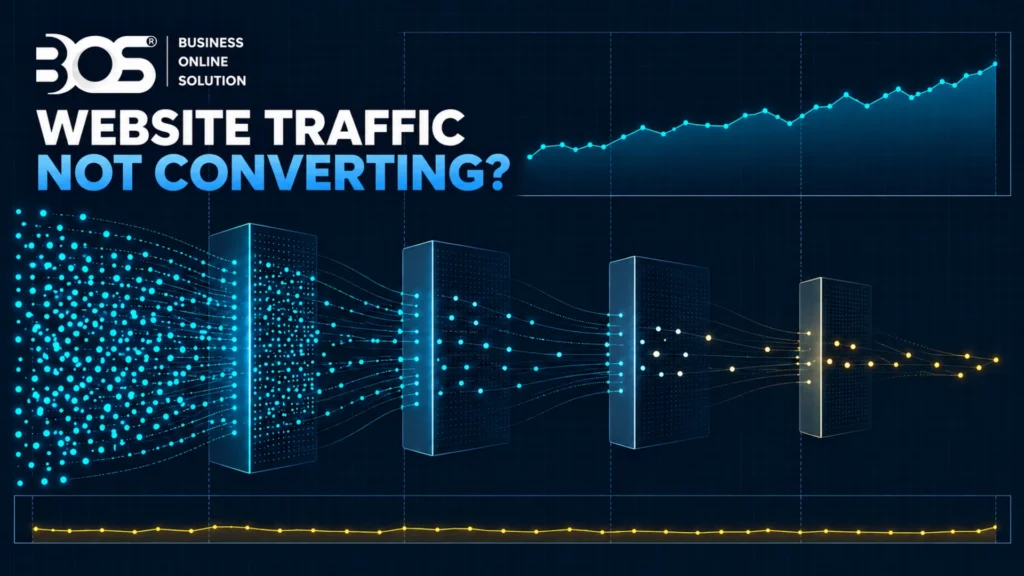
Website traffic not converting into leads or sales is a frustrating problem. Visitor numbers rise, analytics reports look healthier, yet enquiries remain flat and revenue barely moves. It is tempting to conclude that the business simply needs an even larger audience.
That response may mean publishing more articles, increasing the advertising budget or chasing higher rankings. It can work when demand is the actual constraint. When existing visitors fail to take meaningful action, however, more traffic sends more people through the same weak process.
The better question is: What prevents the visitors you already have from becoming customers?
What does “website traffic not converting” actually mean?
Conversion can mean different things at different stages. A visitor might request a quote, book a call or buy a product. An enquiry can then become a qualified opportunity, and an opportunity can become a sale. If a company measures only purchases, it may overlook valuable early actions. If it measures only form submissions, it may mistake poor-quality leads for commercial progress.
Define the outcome before trying to improve it. An online shop may focus on completed orders and margin. A service business may need to measure both qualified enquiries and closed deals. The entire path matters:
Relevant visits → enquiries or purchases → qualified opportunities → customers → revenue → profit
Each stage depends on the one before it. A page can attract thousands of visits and still make a small contribution to the business if its audience is unlikely to buy. Equally, a modest number of visits from people with a clear need can produce meaningful revenue.
For a service business, a simplified revenue model is:
Revenue = visits × visitor-to-lead rate × lead qualification rate × lead-to-customer rate × average initial sale value
This is a diagnostic model, not a forecast. Actual results also depend on repeat purchases, sales cycles, attribution and delivery costs.
Consider an illustrative example. A business receives 10,000 visits, converts 1% into enquiries, qualifies 50% of those leads and closes 20% of the qualified opportunities. At an average initial sale value of €5,000, that produces €50,000 in initial sales. Increasing visits by 50% with every other rate unchanged would produce €75,000. Keeping traffic steady and improving the visitor-to-lead rate from 1% to 2% would produce €100,000, assuming lead quality and close rate hold steady. These are hypothetical figures, and neither scenario describes profit: acquiring and serving the extra customers has a cost.
The value of another visitor depends on what happens after the visit. When website traffic is not converting, first identify which stage is underperforming; otherwise, an attractive growth chart can hide an expensive problem.
Five reasons website traffic is not converting
1. Visitors are interested in the topic but not ready for your offer
Someone researching a broad question may appreciate your article without needing your service. An increase in visits to general educational content can therefore coexist with flat enquiries.
For SEO, examine the queries and pages attracting clicks. Are people looking for a solution your business sells, comparing suppliers, or simply learning a definition? Those audiences need different content and different next steps. Google Search Console shows search performance by query and page; pairing it with Google Analytics helps you examine what visitors do once they arrive. Google’s guidance on using Search Console and Analytics together explains the distinction between search visibility and on-site behaviour.
The practical response is to map important search topics to buying intent. Keep useful educational pages, but connect them to specific service pages, relevant examples and a sensible next action. A reader researching a problem may want a practical guide first; a reader comparing providers may need details of your approach and evidence of your work. Google recommends creating helpful content for people, rather than pages made primarily to capture search traffic. Read Google’s guidance on helpful, reliable content.
2. Your offer does not answer the buyer’s main questions
Visitors should be able to understand who a service is for, what problem it solves and what happens if they contact you. A page that promises “innovative solutions” without explaining the work, process or expected fit leaves the buyer to resolve too many questions alone.
Review your most important landing pages as a prospective customer would. Is the offer specific? Are the services and deliverables clear? Do examples support the claims? Can buyers tell whether you serve businesses like theirs? Is there enough information to decide whether a conversation is worthwhile before filling in a form?
Better messaging can improve the quality of enquiries as well as the quantity. A more precise offer may deter people who were unlikely to become customers, which is often a good commercial outcome.
3. The journey from landing page to action is unclear
A useful article cannot compensate for a confusing next step. Visitors may reach a service page and encounter an unclear call to action, a form that asks for too much information, poor mobile usability or important details hidden in dense copy.
Look at the journey from the pages that attract visitors to the pages where they enquire or purchase. Do high-traffic articles give interested readers a relevant route to a service? Check the experience on a phone. Make the next action easy to find and explain what the visitor can expect after submitting a request. Prioritise changes on pages with evidence of relevant demand; avoid redesigning everything at once.
4. The numbers count enquiries but hide lead quality
More form submissions can look like growth even when most of them fall outside your target market. If a campaign doubles enquiries but sales rejects nearly all of them, the marketing report and the sales report are telling different stories.
Agree on what a qualified lead means: relevant service need, suitable budget or project scale, the right location, and a realistic buying timeframe, where applicable. Record why opportunities do not progress. That feedback tells you whether to change targeting, page messaging, qualification questions or the offer itself.
In GA4, you can mark important actions such as lead generation as key events and examine them in acquisition and landing-page reporting. Tracking a submitted form is useful, but it does not on its own establish that the lead became a customer. See Google’s documentation on key events.
5. The problem happens after the website visit
Marketing may generate suitable enquiries that are answered too slowly, lack a clear next step or never receive a follow-up. An analysis of website traffic alone cannot reveal that failure. The audience and offer may be sound, while the sales handoff prevents growth.
Track the handoff: how quickly enquiries receive a response, how many reach a discovery call or proposal, why deals are lost and how long a typical sale takes. For businesses with repeat orders or ongoing contracts, measure customer retention and value over time as well. A traffic strategy can only be judged properly alongside the economics of the customers it brings in.
How to diagnose website traffic not converting
Start with a small set of connected measures rather than one headline number.
| If you see… | Investigate… | A sensible next move |
|---|---|---|
| Traffic rising; relevant enquiries flat | Which queries, channels and landing pages account for the increase | Improve the match between search intent, content and offer |
| Enquiries rising; qualified leads flat | Who is contacting you and why leads are rejected | Refine targeting and make the offer more specific |
| Qualified leads rising; sales flat | Response times, proposals, pricing and lost-deal reasons | Improve the sales handoff and address recurring objections |
| Customers rising; profit flat | Acquisition costs, margins, fulfilment and retention | Adjust pricing, channel investment or customer mix |
Compare these measures by channel and landing page over a period long enough to account for the sales cycle. A monthly snapshot can mislead when a lead takes weeks to become a customer. A sitewide conversion rate can also hide the cause: an influx of early-stage readers can lower the average even when enquiries from high-intent pages are holding steady. Be careful with last-click reports, too: a buyer may discover you through an article and return later through another channel. Use attribution as evidence, while checking it against actual enquiries and sales records.
Once the bottleneck is clear, change one material part of the journey and measure the result. If people do not find the service, distribution and SEO may deserve investment. If the right visitors arrive but do not enquire, investigate the offer and page experience. If qualified leads arrive but do not close, examine the sales process before buying more clicks. The phrase “website traffic not converting” describes a symptom; the data should tell you which cause to address.
When should you invest in more traffic?
There is a point at which additional traffic becomes the sensible next step. If a business consistently attracts the right audience, turns a healthy share into qualified opportunities, closes those opportunities profitably and has capacity to serve more customers, then increasing relevant reach can accelerate growth.
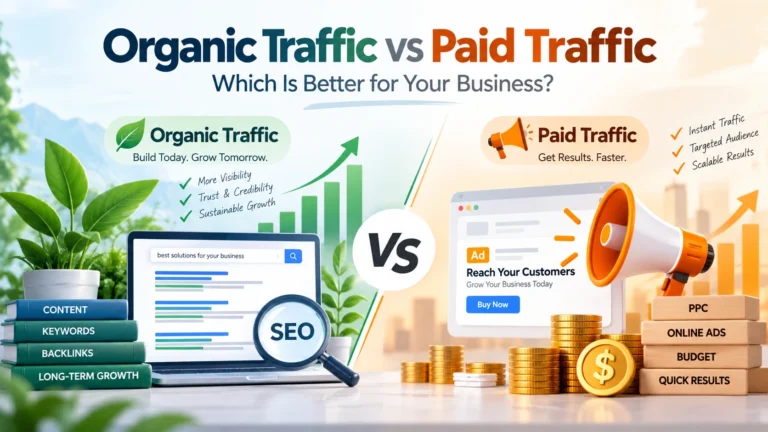
The objective is therefore not to stop pursuing traffic. It is to earn or buy traffic with a clear understanding of its commercial value. That may mean expanding useful SEO content, strengthening pages for high-intent searches, or running paid campaigns with a defined cost per qualified opportunity. For a closer look at the channels, read BOS Marketing’s guide to organic traffic vs paid traffic.
A better growth question
Before setting a higher traffic target, ask: What happens to the next 1,000 relevant visitors?
If you can estimate how many will enquire, how many will qualify, how many will become customers and what those customers are worth, you have a basis for deciding how much more traffic to pursue. If you cannot, that uncertainty is the first problem to solve. When website traffic is not converting, increasing visitor volume without this diagnosis is a weak substitute for a growth strategy.
At BOS Marketing, we look at the connection between visibility, website experience and commercial results. If your traffic is growing but your business is not, contact BOS Marketing to discuss where the customer journey is losing momentum and which improvements are worth testing first.
Frequently asked questions
Why is my website traffic not converting into sales?
If website traffic is not converting into sales, visitors may have low buying intent, the offer may be unclear, the page may make purchasing difficult, or enquiries may be lost during follow-up. Compare performance by landing page and channel, then examine each stage from visit to sale before choosing a fix.
Is more website traffic always good for business?
Additional relevant traffic can create more opportunities, but visitor volume alone does not show whether marketing is profitable. Assess lead quality, customer acquisition cost, sales and margin alongside visits.
Should I work on SEO or conversion first?
Use the bottleneck to decide. If the right audience is not finding you, improve visibility. If suitable visitors arrive but rarely take the next step, examine your offer and website experience. Many businesses need both, but the order of investment should follow the evidence.
What should I track beyond website visits?
Track important actions, qualified leads, sales outcomes, revenue and acquisition costs. For repeat-purchase businesses, include retention and customer value over time. Segment the numbers by channel and landing page so you can identify where growth comes from.