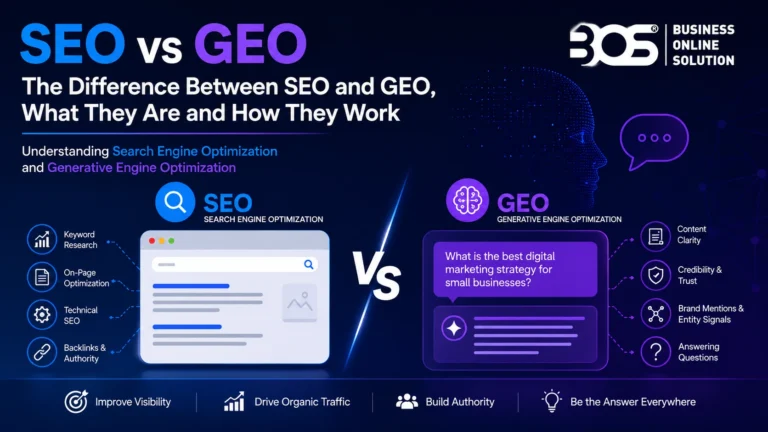


TL;DR: SEO (Search Engine Optimization) is the process of optimizing your website so it appears as high as possible in Google’s results. When someone searches for something on Google, the pages that show up first get the vast majority of clicks, and SEO is what gets you there without paying for ads.
Why Does SEO Matter?
Most people never go past the first page of Google. Studies show that the top 3 results get over 60% of all clicks. If your page isn’t there, you practically don’t exist for most searchers.
Here’s why SEO matters for businesses: unlike paid ads, visitors from SEO don’t cost you per click. People trust organic results more than advertisements. A well-optimized page continues to bring visitors for months and years. And someone searching “car rental tirana” has clear intent, they want to rent a car, not just browse.
The Three Pillars of SEO
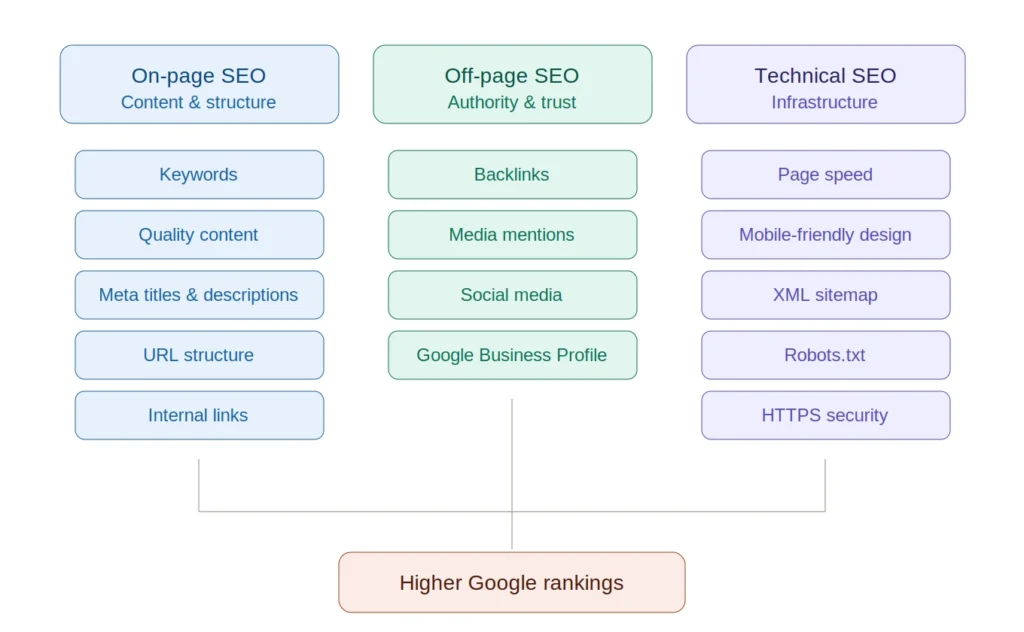
SEO is divided into three main categories. Each has its own role, and none works without the others.
1. On-page SEO
This covers everything on your website that affects how Google understands and ranks your content. Keywords are the terms people use when searching on Google, you need to use them naturally in your title, headings (H1, H2, H3), and body text. Quality content means articles, guides, and pages that answer real questions, not text stuffed with keywords. Meta titles and descriptions are what appear in Google results, they’re your free advertisement. Clean URL structure matters too: URLs like “/what-is-seo/” are far better than “/page?id=123“. And internal links between your pages help both users and Google navigate your site.
2. Off-page SEO
This covers actions outside your website that build your authority. Backlinks are when other trusted websites link to yours, Google sees this as a “vote of confidence.” Media mentions, interviews, or references on well-known sites also strengthen your authority. Social media doesn’t directly affect rankings, but it helps spread your content and build your brand. And for local businesses, a complete Google Business Profile on Google Maps is essential. For businesses targeting a specific area, local SEO is worth understanding separately.
3. Technical SEO
This is the “infrastructure”, Google needs to be physically able to find, read, and understand your page. Page speed matters because slow pages get penalized by Google and abandoned by visitors. Responsive design is critical since over 70% of searches happen on mobile, your site must work perfectly on phones. An XML sitemap is a map of your site that tells Google which pages exist. A robots.txt file tells Google which pages to scan and which to skip. And HTTPS security is favored by Google, sites with SSL certificates rank better.
How Google Works: A Simple Explanation
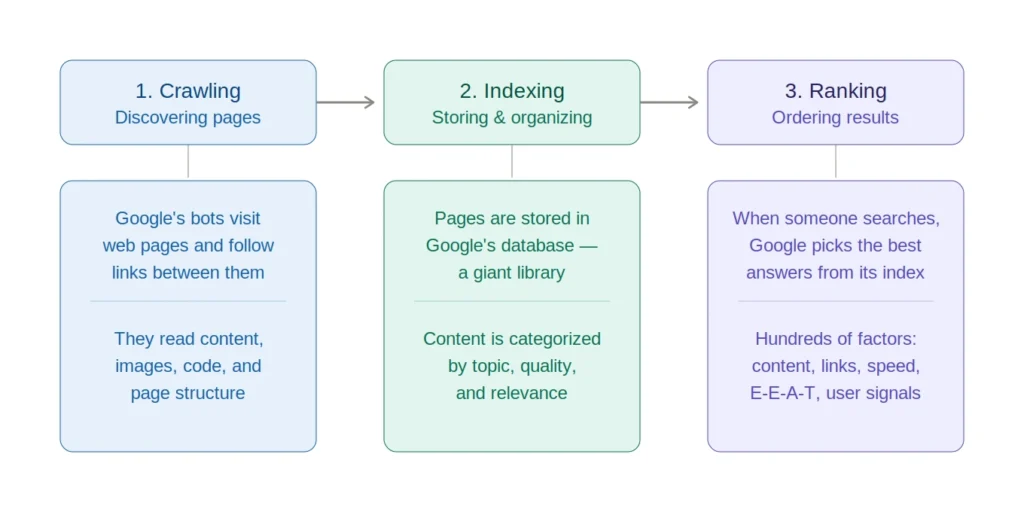
To understand SEO, you need to understand how Google’s search engine works. The process has three steps.
First, crawling: Google has “robots” (crawlers) that visit web pages and read their content, following links from one page to the next. Second, indexing: after reading a page, Google stores it in its database (the index), think of it as a giant library where every web page has its place. Third, ranking: when someone makes a search, Google reviews its index and decides which pages best answer the query. Google’s algorithms use hundreds of factors to make this decision.
E-E-A-T: What Google Wants from Your Content
In recent years, Google has increasingly emphasized the concept of E-E-A-T: Experience (does the author have real experience with the topic?), Expertise (do they know the field well?), Authoritativeness (are they recognized as a trusted source?), and Trustworthiness (can the page and author be trusted?).
This is especially important in the era of Google AI Mode, where AI decides which sources to cite in its responses. Without E-E-A-T, your page simply won’t be selected.
SEO vs Paid Advertising: What’s the Difference?
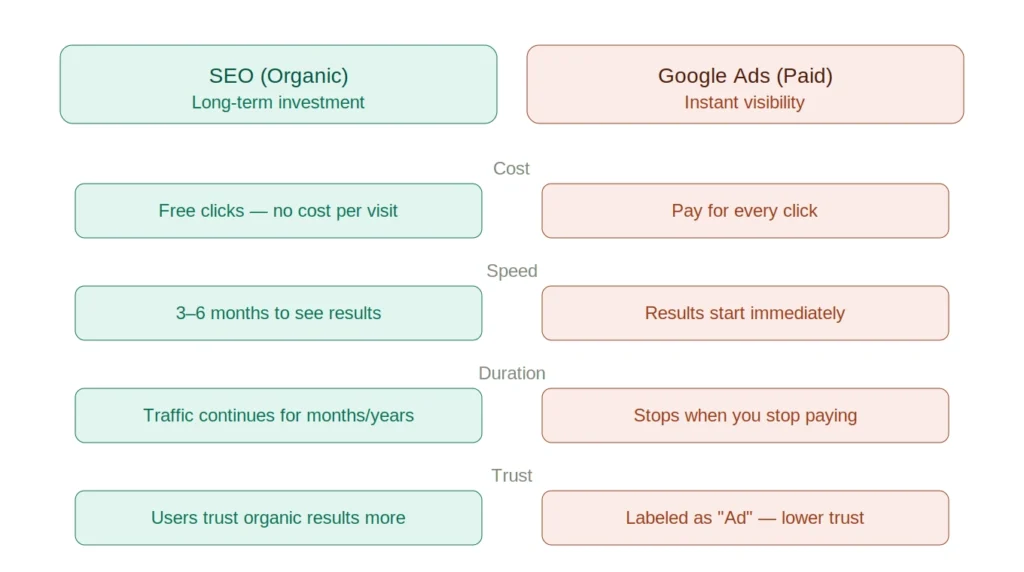
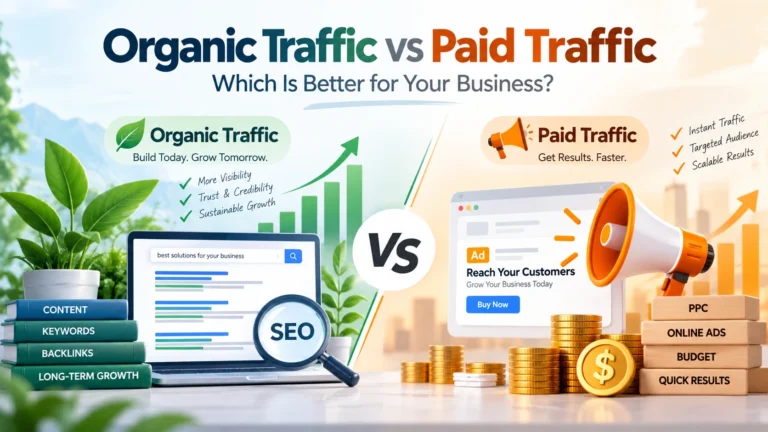
Many people confuse SEO with Google Ads. With SEO, you don’t pay for clicks, results come from the quality of your site and content. It takes time (usually 3–6 months) but delivers long-term results. With Google Ads, you pay for every click, results are immediate but stop the moment you stop paying.
The ideal strategy combines both, but SEO remains the foundation because it builds sustainable value.
The Most Common SEO Mistakes
Many businesses make mistakes that cost them time and money.
Keyword stuffing: repeating your keyword 20 times in one article doesn’t work, Google penalizes this practice. Copying content: word-for-word translations of English articles or copying from competitors lowers your authority. Ignoring technical SEO: a beautiful site without speed, sitemap, or HTTPS won’t rank well. Unrealistic expectations: SEO takes time, no one can guarantee you first place within a week. Focusing only on traffic: traffic without conversion has no value. 100 targeted visitors are worth more than 10,000 random ones.
How to Get Started with SEO
Start by registering your site in Google Search Console, Google’s free tool that shows you everything about your search performance. Next comes keyword research: find the terms people actually use when searching for your services or products, not what you assume they search. Build quality content on top of that, articles that answer real questions and follow a clear content strategy. Technical optimization, speed, mobile functionality, and clean structure should be in place before you invest time in content. Backlinks start with your Google Business Profile and local directories. SEO isn’t “set and forget”: check performance monthly and adapt your strategy as the data accumulates. For a practical breakdown of each step, see how to rank higher on Google.
Frequently Asked Questions
How much does SEO cost?
It depends on your site and competition. Professional SEO usually costs $500–$2,000 a month in the UK and US, while BOS.al’s monthly SEO packages are €400–€600. See what an SEO agency does to know what should be included.
Can I do SEO myself?
The basics, yes. Free tools like Google Search Console are enough to start. For a serious strategy and faster results, an experienced agency makes the difference.
How does AI affect search?
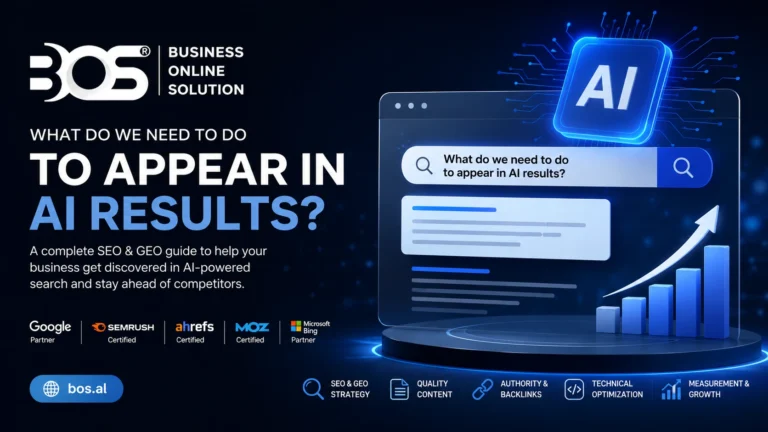
Google AI Mode still relies on websites for its answers, so quality pages remain essential. The difference now is that you also optimize to be cited by AI. ChatGPT won’t replace SEO, but it is changing the game.
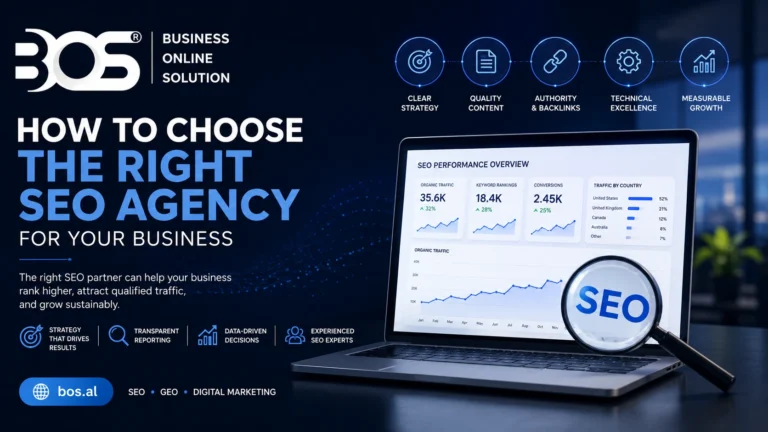
If you want Google to find and rank your site, our SEO services cover all three pillars for Albanian and international businesses.
Key Takeaways
- SEO is optimizing your site for Google: it includes content, technical factors, and authority, delivering free long-term traffic.
- The three pillars are on-page, off-page, and technical SEO: none works without the others.
- E-E-A-T determines success: Google wants real experience, expertise, authority, and trustworthiness.
- SEO takes time but delivers lasting results: 3–6 months minimum, but traffic keeps coming without paying per click.
- With the arrival of AI, SEO has evolved, not died: it now includes optimization for Google AI Mode and AI Overviews.