

TL;DR: A website in the UK costs between £0 and £10,000+ depending on the route you take. DIY builders start at £10–£40/month, freelancers charge £500–£3,000, UK agencies charge £3,000–£10,000, and overseas European agencies deliver comparable quality for £1,200–£3,000.
Website pricing summary: Most small businesses should expect to spend between £1,500 and £5,000 for a professional website that actually works. Anything under £500 usually looks like it, and anything over £8,000 is overkill for a small business unless you need e-commerce or custom functionality. The rest of this guide breaks down exactly where that money goes and which route makes the most sense for your budget.
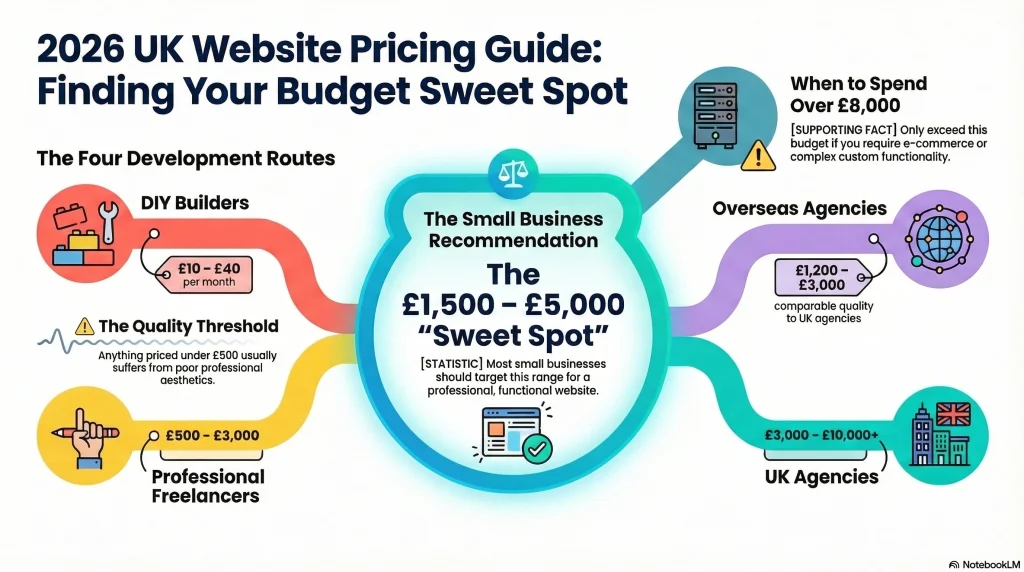
The Four Routes to a Small Business Website
There isn’t one price for a website — there are four completely different approaches, each with different costs, quality levels, and trade-offs.
Route 1: DIY Website Builders (£0–£40/month)
Platforms like Wix, Squarespace, and GoDaddy let you build a website yourself using drag-and-drop tools and pre-made templates.
What it costs: Free plans exist but come with the platform’s branding and a non-custom domain (yoursite.wix.com). Paid plans that give you a proper domain and remove branding cost £10–£40 per month, which works out to £120–£480 per year.
What you get: A functional website that you build and maintain yourself. Templates look decent out of the box, and you don’t need coding skills. Basic contact forms, image galleries, and blog functionality are included.
The trade-offs: You’re limited by the template. Customisation beyond moving blocks around is difficult. SEO capabilities are basic compared to WordPress. Loading speed is often mediocre. And the time you spend building and tweaking the site yourself is time you’re not spending on your actual business.
Best for: Sole traders and very early-stage businesses who genuinely have no budget and are comfortable spending 20–40 hours figuring out the platform.
Route 2: Freelance Web Designer (£500–£3,000)
Hiring a freelancer — through platforms like Upwork, Fiverr, or local recommendations — gets you a custom-designed site without the overhead of an agency.
What it costs: A simple five-page website from a competent freelancer costs £500–£1,500. A more complex site with booking systems, blog setup, or e-commerce functionality runs £1,500–£3,000.
What you get: A website designed specifically for your business, usually on WordPress. The freelancer handles design and development, and often basic on-page SEO.
The trade-offs: Quality varies enormously. A £500 freelancer and a £2,500 freelancer deliver very different results. There’s typically no project management structure — it’s just you and one person. If that person gets busy, sick, or disappears, your project stalls. Post-launch support is often limited or nonexistent.
Best for: Small businesses with a moderate budget who can invest time in finding and vetting a reliable freelancer.
Route 3: UK-Based Agency (£3,000–£10,000+)
A local agency gives you a full team — designer, developer, project manager, and sometimes a copywriter and SEO specialist.
What it costs: A standard five-page business website from a UK agency costs £3,000–£6,000. Sites with e-commerce, booking systems, or custom functionality start at £6,000 and can exceed £10,000. London agencies tend to charge more than regional ones.
What you get: A professionally designed and developed website with proper project management, structured timelines, multiple rounds of revisions, and post-launch support. Many agencies also include basic SEO setup, GDPR compliance, and analytics integration.
The trade-offs: It’s the most expensive option. For a small business that just needs a clean, professional site with five to ten pages, spending £6,000+ can be hard to justify — especially when the same result is available for significantly less through other routes.
Best for: Medium-sized businesses with larger budgets who want a fully managed experience and prefer face-to-face meetings. Not sure how to evaluate agencies? Here’s our guide on how to choose a marketing agency.
Route 4: Overseas European Agency (£1,200–£3,000)
European agencies — particularly in Eastern Europe — offer the same team structure and quality as UK agencies, but at significantly lower prices because of lower operating costs.
What it costs: A five-page business website costs £1,200–£2,000. A site with e-commerce, blog, and local SEO runs £2,000–£3,000.
What you get: The same deliverables as a UK agency — custom design, mobile responsiveness, SEO basics, GDPR compliance, project management, and post-launch support. Communication is in English, contracts can be UK-compliant, and timezones overlap significantly (most European agencies are 1–2 hours ahead of the UK).
The trade-offs: No face-to-face meetings. Communication happens over Zoom, WhatsApp, and email. For some business owners, this feels uncomfortable — although in practice it works identically to how most UK agencies operated during and after the pandemic.
Best for: Small businesses that want professional agency-quality work but don’t have £5,000+ to spend. This is where most UK small businesses get the best value for money in 2026. Read more about outsourcing web design overseas safely or see what’s included in our web design for small business UK packages.
What Actually Drives the Cost Up or Down
Regardless of which route you choose, the final price depends on a few key factors:
Number of pages. A five-page site costs less than a twenty-page site. Each additional page requires design, content, and development time. A general rule: budget roughly £100–£200 per additional page beyond the standard package.
Custom design vs templates. A fully custom design — where every element is created from scratch for your brand — takes significantly more time than customising an existing template. Templates aren’t bad (most successful small business sites use them), but custom design gives you a unique look. It also costs 2–3x more.
E-commerce functionality. Adding a shop with product listings, payment processing, stock management, and shipping calculations adds £1,000–£5,000+ depending on complexity. A simple shop with 20 products costs far less than a catalogue with 500 items, multiple payment methods, and automated email sequences.
Booking or reservation systems. If customers need to book appointments, tables, or services online, that integration adds £300–£1,000 depending on the platform and complexity.
Content creation. If you need the agency to write your website text, take photos, or create graphics, that’s extra. Copywriting for a five-page site typically costs £300–£800. Professional photography can cost £200–£500 for a half-day shoot.
SEO setup. Basic on-page SEO (title tags, meta descriptions, heading structure, image optimisation) is included in most agency quotes. You can check any website’s performance for free using Google PageSpeed Insights. More advanced SEO — keyword research, local SEO, content strategy, link building — is usually a separate ongoing cost of £200–£500 per month.
The Hidden Costs Most Guides Don’t Mention
The sticker price of building your website isn’t the full story. Budget for these ongoing costs as well:
Domain name: £8–£15 per year. This is your web address (yourbusiness.co.uk).
Hosting: £3–£30 per month depending on the provider and plan. Shared hosting is cheapest. Managed WordPress hosting costs more but is faster and more secure.
SSL certificate: Often included free with hosting, but verify this. It’s what gives your site the padlock icon and HTTPS — essential for both security and Google ranking.
Maintenance and updates: WordPress sites need plugin updates, security patches, and occasional bug fixes. If you’re not technical, a maintenance plan costs £30–£100 per month. Some agencies include this for the first few months.
Email: Professional email (info@yourbusiness.co.uk) costs £1–£5 per mailbox per month through Google Workspace or Microsoft 365.
Annual total for ongoing costs: Budget roughly £300–£800 per year on top of the initial build cost.
How to Get the Best Value in 2026
Based on what we see in the market, here’s the most practical advice for UK small businesses:
If you have under £500: Use a DIY builder like Squarespace. It’s not perfect, but it’s far better than having no website. You can always upgrade later.
If you have £500–£1,500: Hire a good freelancer. Vet them carefully — check their portfolio, read their reviews, and start with a small test project if possible.
If you have £1,500–£3,000: Consider an overseas European agency. You’ll get agency-level quality — custom design, proper SEO, project management, and post-launch support — at a price that makes sense for a small business.
If you have £3,000+: You have the budget for a UK-based agency. This makes sense if you want in-person collaboration or have complex technical requirements.
The most important thing is this: a £1,500 website that goes live and starts working for your business is infinitely more valuable than a £5,000 website that you keep postponing because the budget isn’t there yet. Get online. Improve later.
Key Takeaways
- Most UK small businesses spend £1,500–£5,000 on a website. The right amount depends on your route: DIY (£0–£40/month), freelancer (£500–£3,000), UK agency (£3,000–£10,000), or overseas agency (£1,200–£3,000).
- The biggest cost drivers are design complexity, number of pages, and e-commerce. A standard five-page business site is always the cheapest option.
- Budget £300–£800 per year for ongoing costs including hosting, domain, SSL, email, and maintenance.
- Overseas European agencies offer the best value in 2026 — agency-level quality at freelancer-level prices, with English communication and UK-compatible timezones.
- A live £1,500 website beats a delayed £5,000 one. Get online first. Improve over time.
Looking for a transparent quote? BOS.al is a web design agency based in Tirana, Albania that works with UK small businesses. Professional websites from £1,200, with milestone-based payments and a portfolio you can test yourself. Get a free quote.