


TL;DR: Google AI Mode is turning search into a conversation with artificial intelligence — users get complete answers without clicking a single link. For businesses and marketers, this doesn’t mean websites are becoming irrelevant. It means your content needs to be good enough for Google’s AI to choose it as a source.
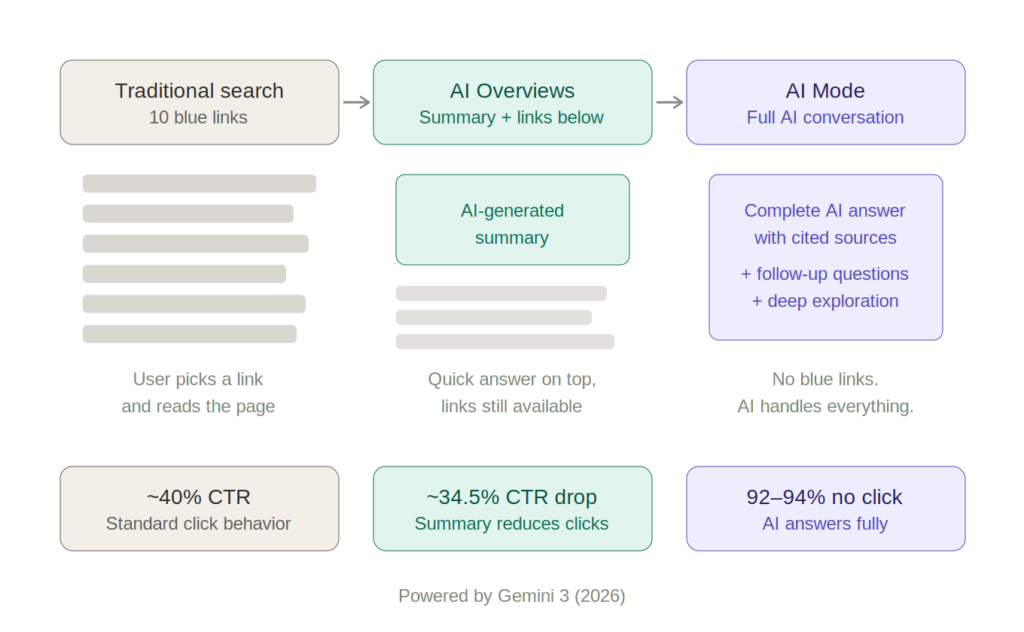
Google AI Mode is a new way to search where Gemini, Google’s AI model, generates complete answers instead of the traditional list of 10 blue links. It’s not just a short summary at the top of the page (like AI Overviews) — it’s a full conversational interface where you can ask follow-up questions, get comparative analyses, and explore topics in depth without ever leaving Google.
AI Mode was first introduced as an experiment in Google Labs in March 2025. After Google I/O in May 2025, it became available to all users in the US. Since then, it has expanded to over 200 countries and territories, with support for languages including Arabic, Chinese, Malay, and Urdu. In January 2026, Gemini 3 became the default model powering both AI Mode and AI Overviews globally.
The key difference from AI Overviews: AI Overviews appear as a box above the traditional results — the blue links remain below. AI Mode completely replaces the classic results with an AI conversation. Think of it as ChatGPT built directly into Google Search.
How AI Mode Works — The Technical Side
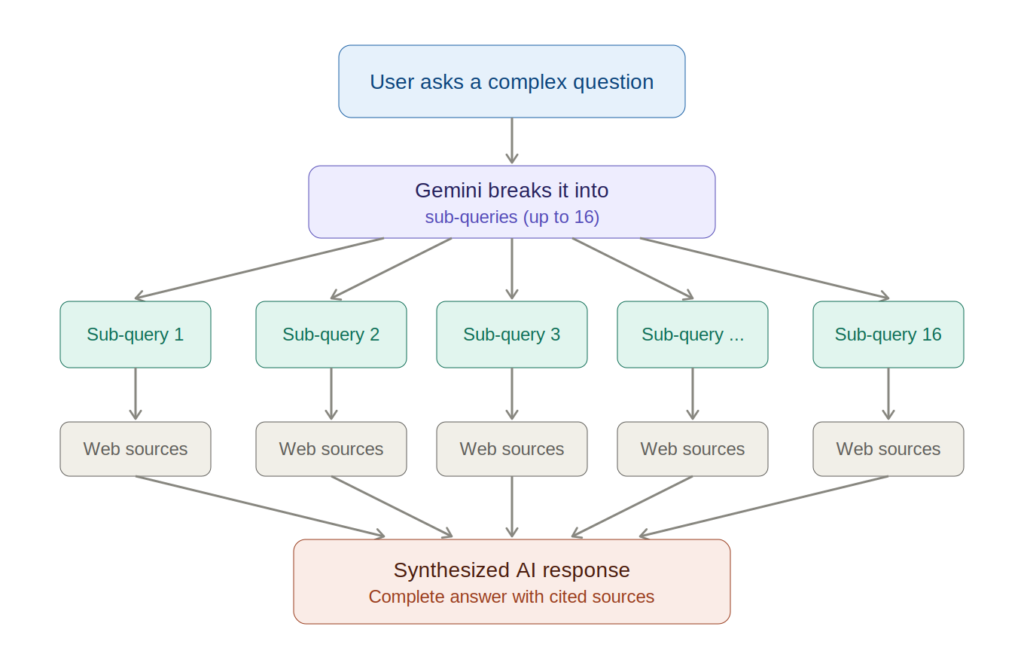
Unlike Google’s traditional search engine, AI Mode uses a system called “query fan-out” — instead of running a single search, it breaks your question into multiple sub-queries (up to 16 parallel searches), gathers answers from different sources, and synthesizes them into a single comprehensive response.
Queries in AI Mode are on average twice as long as traditional searches (7.2 words vs 4 words). Around 25% of users ask follow-up questions within the same conversation. Content gets cited with sources, but users have little reason to click through if the answer is complete.
In early 2026, Google introduced two major upgrades. First, Gemini 3 became the default model for AI Overviews worldwide, delivering significantly improved response quality. Second, users can now ask follow-up questions directly from AI Overviews and seamlessly transition into an AI Mode conversation — creating one fluid experience. Google also launched Personal Intelligence, which connects Gmail, Google Photos, and other apps to deliver personalized search responses. Originally limited to paid subscribers, Personal Intelligence is now available to all free users in the US.
The Real Impact on Traffic: What the Data Shows
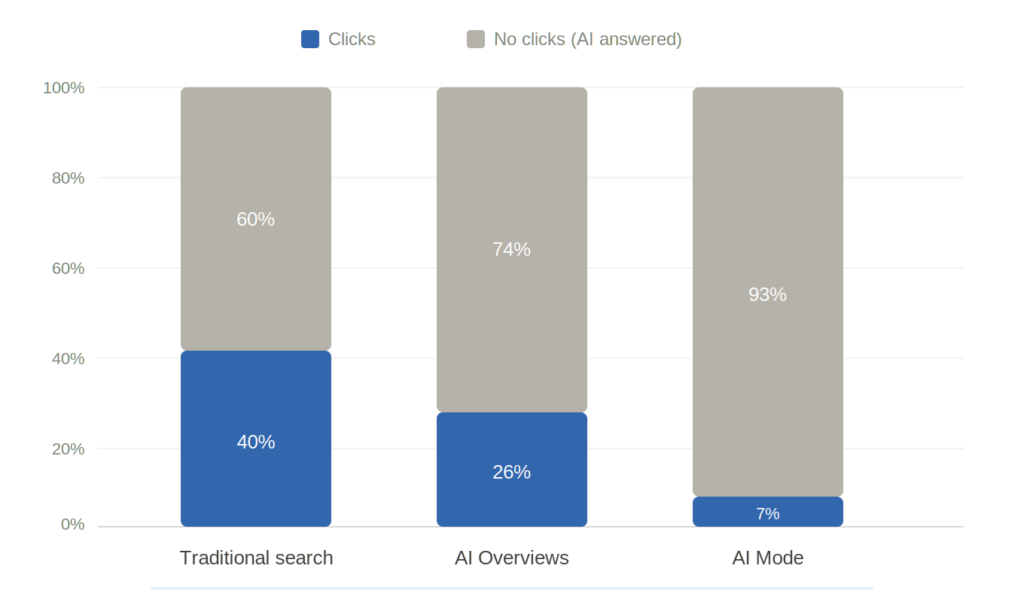
Let’s talk numbers, not assumptions:
The decline in clicks is real, but nuanced. AI Overviews, which are the lighter version of AI Mode, have reduced average CTR by approximately 34.5%. In AI Mode, the situation is even more pronounced — 92–94% of sessions end without a single click.
However, early reports suggest that visitors who come through AI Mode citations have stronger intent and convert at higher rates. This means that even with fewer visits, ROI can be positive — if you’re among the cited sources.
Google reports over a 10% increase in search usage for query types where AI Overviews appear. Users aren’t leaving Google — they’re searching more, just differently.
What Does This Mean for Your Business?
Whether AI Mode is fully active in your market or not, the shift is already underway. AI Overviews are appearing in search results across many countries. When AI Mode reaches your language and region, the change will be immediate.
Businesses that build authority and quality content now will be the first sources AI cites. The competition in many local markets is still low — most websites don’t have a serious digital marketing strategy. That’s an opportunity, not a problem.
The SEO Strategy That Works in the AI Era
The good news: Google has officially confirmed that there are no special technical requirements to appear in AI Overviews or AI Mode. Standard SEO best practices remain valid. But some things carry more weight than before:
E-E-A-T — More Important Than Ever
E-E-A-T (Experience, Expertise, Authoritativeness, Trust) isn’t just a checklist — it’s the filter that determines whether Google’s AI will cite you or not.
Write from your direct experience, not translations of other people’s articles. Show that you know your field — use data, concrete examples, case studies. Build quality backlinks from trusted sources and earn mentions in media. Have a clear author bio, cite your sources, and update your content regularly.
Structure Your Content for AI
AI Mode doesn’t read articles like humans do — it extracts information. Make its job as easy as possible:
Give the answer in the first sentence after the heading, then expand. Use lists, tables, and clear formatting. Implement Schema Markup (FAQ, HowTo, Article) to help Google understand your content structure.
Focus on Unique, Original Information
In an internet flooded with recycled content, AI seeks out unique sources. This is your advantage as a local business:
Publish real market prices (nobody else does). Share real client case studies. Offer perspectives that come from direct experience in your market. Create content that can’t be found by simply translating English-language articles.
Diversify Your Traffic Sources
Organic SEO remains important, but it shouldn’t be your only channel:
Build your email list and invest in email marketing. Strengthen your presence on social media. Optimize your Google Business Profile for local visibility. Seek direct referrals from partners and clients.
How to Monitor Performance in the Age of AI Mode
This is perhaps the biggest challenge right now: Google does not yet offer dedicated reporting for AI Mode in Google Search Console. AI Mode traffic is included in the general “Web” report without being separated.
Monitor the overall trend of clicks and impressions in GSC. Track your visibility through tools like Ahrefs or SEMrush. Watch for patterns where CTR drops while impressions rise — this is a sign of AI Overviews. Manually check whether your content is being cited by running relevant queries in AI Mode.
FAQ
What is Google AI Mode and how does it differ from AI Overviews?
AI Overviews appear as a box above the blue links. AI Mode completely replaces the blue links with an AI conversation — like ChatGPT inside Google.
Will my website lose traffic from Google AI Mode?
Yes — 92–94% of AI Mode sessions end without a click. But websites that get cited as sources receive visitors with higher conversion rates.
How can I ensure my content gets cited by AI Mode?
Create original content, use clear structure with headings and lists, add Schema Markup, and build quality backlinks. There are no additional technical requirements — Google has confirmed this.
Is AI Mode available worldwide?
AI Mode and Search Live are now available in over 200 countries and territories. Gemini 3 powers AI Overviews globally. Personal Intelligence is currently available to all users in the US, with further expansion expected.
Is SEO dead?
No. Google still needs quality content — without websites, AI Mode has nothing to cite. The difference is that now you need to be the source AI chooses, not just rank high in a list.
Key Takeaways
Google AI Mode is turning search into an AI conversation — the classic 10 blue links are gradually being replaced by comprehensive answers from Gemini, now powered by Gemini 3 globally.
92–94% of AI Mode sessions end without a click — but visitors who do click through have stronger intent and higher conversion rates.
No special technical requirements — Google has confirmed that standard SEO best practices remain the foundation; focus on content quality and E-E-A-T.
The window of opportunity is real — in many markets, competition for AI-ready content is still low. Businesses that build authority now will be the first sources AI cites.
Diversify your traffic sources — don’t rely solely on Google organic; invest in email, social media, and direct referrals.
Contact us for a free SEO consultation — the BOS.al team will help you prepare for the new era of AI-powered search.