

TL;DR: ChatGPT will not replace SEO. It changes how people search and how content is evaluated, but SEO still requires human expertise, strategy, and trust-building.
ChatGPT replacing SEO: No. ChatGPT and other AI tools will not replace SEO as a profession or as a business function. They change how SEO is done, not whether it is needed. SEO is still required to earn visibility, trust, and long-term traffic in Google and AI-driven search experiences.
This still depends on the same fundamentals explained in our guide on how to rank higher on Google, where strategy, structure, and authority matter more than tools.
That’s the answer. Everything else below explains why.
What Actually Changed After AI Entered Search
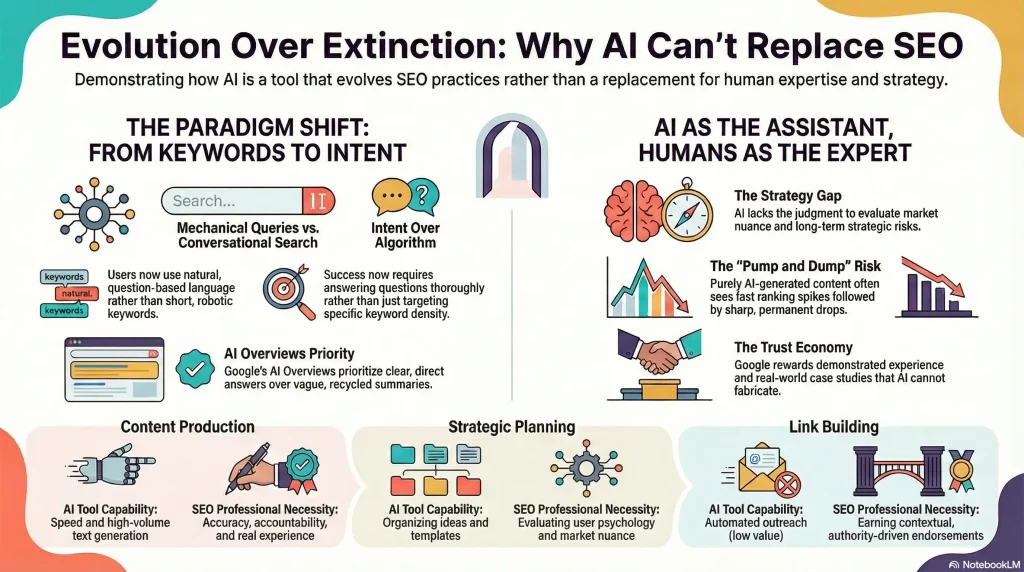
The most visible change since AI became mainstream is how people search. Queries are no longer short or mechanical. They are conversational, contextual, and question-driven.
This didn’t eliminate keywords. It exposed intent.
Google has always tried to understand what users want. AI simply accelerated this process by changing user expectations. People now want clear answers, not vague content written to satisfy an algorithm. If you want the clearest example of this shift in action, Google’s AI Overviews are already changing what users see first we broke it down in our analysis of Google AI Overviews and what they mean for SEO.
As a result, pages that exist only to “target a keyword” are slowly losing visibility. Pages that explain, compare, and answer questions thoroughly are gaining it.
This isn’t a new SEO principle — it’s SEO working as intended.
Why the “SEO Is Dead” Narrative Failed
The panic around AI replacing SEO came from a misunderstanding of what SEO actually is. We’ve seen the same fear pattern before with new technologies, including AI-driven development tools, which we explored when asking whether innovation actually means replacement in this analysis of Google Antigravity and the future of coding. Many assumed that if AI can write content, then SEO becomes irrelevant.
But SEO was never just about writing.
Real SEO involves:
- Understanding how users think and search
- Translating that intent into structured, crawlable content
- Building authority over time in a way Google can trust
AI can generate text, but it cannot evaluate market nuance, user psychology, or long-term strategic risk. Those decisions still require experience.
This is also where backlinks were misunderstood. Backlinks didn’t lose value — but Google became far better at detecting why a link exists. Links without intent or relevance stopped working. Legitimate endorsements did not.
A Real-World Example That Still Works Today
A car rental website I worked on was buried deep in Google results. The owners spent heavily on ads, but ads didn’t solve the core problem: Google did not trust the site enough to rank it organically.
The SEO work focused on fundamentals:
- Clarifying pages so users and search engines understood them
- Publishing consistent, useful blog content
- Earning backlinks that made sense contextually
Within three months, the website ranked first for its main keyword and top five for several secondary keywords. More importantly, it started generating consistent organic calls every month.
This happened while AI tools were widely available.
SEO didn’t stop working. Poor SEO did.
Where AI Helps — and Where It Fails
I use AI tools daily. They are valuable for speeding up workflows, organizing ideas, and helping turn expertise into structured content.
What AI does not replace is judgment.
Google updates continuously. Even if AI becomes better at generating content, Google simultaneously becomes better at detecting low-value output. That creates a permanent gap between automation and trust.
When businesses rely entirely on AI-generated content, they often see fast rankings followed by sharp drops. That pattern isn’t accidental — it’s structural.
AI works best as an assistant to an expert, not as the expert itself.
Why Google Is Moving Toward Expertise, Not Volume
Google does not need more content. It already has more information than users can consume.
What it needs is confidence.
That confidence comes from:
- Demonstrated experience
- Real examples and case studies
- Clear explanations instead of recycled summaries
This is especially true in smaller or local markets, where trust and relevance matter more than sheer output. AI-only strategies tend to fail faster in these environments.
SEO today rewards clarity, accountability, and experience — not speed.
The Reality of Backlinks Today
Backlinks are harder to earn and less forgiving than before. Their value now depends heavily on intent.
Google evaluates whether a link:
- Makes sense contextually
- Exists for users, not manipulation
- Comes from a site with its own credibility
This doesn’t mean backlinks are weak. It means they require strategy. The volume-driven link-building era is over, but authority-driven linking is still very much alive.
Why SEO Is Still a Full-Time Job
When AI first emerged, it was reasonable to question whether SEO would become a part-time role.
What actually happened is the opposite.
SEO now requires more expertise because mistakes are punished faster. Google doesn’t want raw information — it wants professionals who understand how to present information responsibly and effectively.
SEO didn’t shrink.
It matured.
Key Takeaways
- ChatGPT does not replace SEO; it removes outdated SEO practices
- Search behavior shifted toward questions, not away from search engines
- AI accelerates execution but cannot replace judgment or strategy
- Google increasingly rewards expertise, experience, and trust
- SEO remains essential for long-term, stable visibility