


The cover letter is one of the most misunderstood and underrated documents when applying for a job or university. Many people see it as something optional or formal, but from my experience and from real cases I have seen, the cover letter often has more impact than the CV itself .
This article is not a theoretical guide or a generated text. It is based on real experience, concrete mistakes, and cases that show why and how to write a motivation letter that works.
What is a motivation letter really?
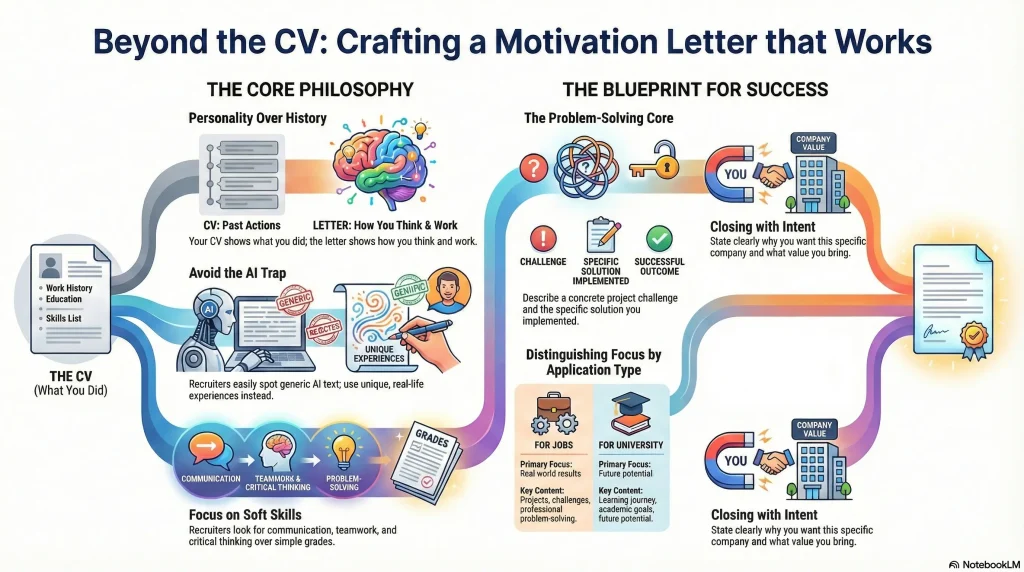
A cover letter is not a summary of your CV. It is not there to show off your grades, certificates or titles, but to explain how you think, how you see the world and what your role is in a team or community .
Although many employers don’t directly ask for it, a cover letter has become increasingly important in recent years. The reason is simple: CVs have become too similar, while the cover letter is the only place where a candidate can show their personality.
The biggest mistake made today
The most common mistake I see is using artificial intelligence to write the cover letter from start to finish. This is a serious mistake.
The cover letter should be unique to each person , built on real life experiences. We’re not just talking about work experience, but also about:
- problems you encountered
- things you learned on your own
- situation where you took responsibility
Recruiters are very quick to spot generic, anonymous letters.
What are recruiters really looking for?
From what I’ve noticed, recruiters don’t want to know how many grades you got or how many certificates you have. They want to understand:
- Are you a communicator?
- Do you know how to work in a team?
- Do you have a critical mind?
- how do you deal with problems
Think of it like a football team: each player has a role. Your cover letter should explain what your role is .
The basic structure of a cover letter
There is no magic formula that works for everyone, but a basic structure is:
- Personal data (name, surname, contact)
- Introductory paragraph: who you are and where you are professionally
- Main paragraph: experiences, projects, challenges and how you solved them
- Closing paragraph: why you are applying and what value you bring
Unlike a CV, which describes what you have done so far, a cover letter shows who you are as a person and how you think. For this reason, the two should work together and not copy each other – if you don’t have your CV ready yet, check out our guide on how to write a CV for a job .
To make it clearer what a naturally written, rather than artificially written, cover letter looks like, below is a concrete example that can be used as guidance.
Example of a motivation letter (for work)
Name Surname
Tirana, Albania
Email: name@email.com
Phone: 06XXXXXXXX
Dear [Company Name / Recruiter],
My name is Name Surname and I am writing to express my interest in the position of [position name] at your company. I have currently completed [education/major experience] and am looking for an opportunity where I can make a real contribution and develop professionally.
During my journey, I have had the opportunity to face situations that have taught me more than theory itself. In [a concrete project, job, or experience] , I was faced with [a real-world problem] , which forced me to think differently and take responsibility. The solution I found was [how you solved it] , and from this experience I learned the importance of communication, collaboration, and perseverance.
I see myself as a communicative person, who works well in a team, but who also knows how to take initiatives when necessary. I don’t claim to know everything, but I am always willing to learn and improve, especially when faced with new challenges.
The reason I am applying to your company is because [specific reasons: values, field, projects, way of working] and I believe that my profile can bring value to your team. I would be very interested in discussing further in an interview how I can contribute.
Thank you for your time and attention.
With respect,
Name Surname
Real case study: why a cover letter changes everything
A friend of mine was constantly applying for jobs and getting no answers. His CV was correct, but something was missing. When a company asked him for a cover letter, he decided not to just write a formal text, but to tell his story: what problems he had gone through, how he had dealt with them, and what he had learned from failures.
The result was immediate. Employers began taking him more seriously and inviting him for interviews, not just for his technical skills, but to understand the way he thought and reacted to challenges.
Motivation letter for work vs. for university
A cover letter for a job focuses more on real-world experiences, projects, and problem-solving. While for a university or scholarship, the focus is on what you have learned, your potential, and future goals.
This becomes even more important today, where many applications are made online and competition is high, especially for work from home jobs , where the cover letter is often the first document read.
Don’t neglect how you submit your application.
Many people focus only on the content of the letter, but forget a very important detail: how they send it.
Cover letters are usually sent via email, and your presentation is just as important as the letter itself. A professional email can make a positive or negative first impression, no matter how good the letter is.
A tip against the current
Most people think that the CV is the most important document. In my experience, the opposite is often true. The cover letter is more important than the CV , because the CV shows what you have done, while the letter shows who you are.
A cover letter is not a formality. It is your opportunity to speak directly to the person reading your application. If you write it based on your real self and not on ready-made templates, it becomes one of the most powerful weapons you have in any application.